Saturday, May 7, 2011


Pak army denies reports of Pasha's resignation


The Pakistani military has denied reports that Inter-Services Intelligence chief Lt Gen Ahmed Shuja Pasha is quitting over the debacle of Osama bin Laden being killed by US forces in the garrison city of Abbottabad and that he travelled to Washington to explain Islamabad's position
.


Seeking to scotch reports that Pasha may be made the 'fall guy' and asked to quit, the military came out with a brief three-line statement.
"Director General Inter-Services Public Relations Major Generel Athar Abbas has rebutted reports regarding resignation of Director General ISI and his visit to the US," it said.


Media reports had said on Saturday that Pasha, who has come in for criticism for the military intelligence set-up's failure to detect bin Laden's presence in Abbottabad, had gone to Washington to discuss with US officials the episode and its aftermath.
The Daily Beast, a website affiliated to Newsweek magazine, had earlier quoted unnamed officials as saying that the ISI chief "may step down, as the government looks for a fall guy for the bin Laden debacle".
It said Pasha's resignation "was only a matter of time".
An official statement issued on Thursday after a meeting of Corps Commanders chaired by army chief Gen Ashfaq Parvez Kayani said the military admitted its "own shortcomings in developing intelligence on the presence of Osama bin Laden in Pakistan".
It said that "an investigation has been ordered into the circumstances that led to this situation".
However, there were reports that Pasha had embarked on Friday on a foreign trip to an undisclosed location that was linked to the killing of bin Laden.
......................................................


Pakistan's ISI chief may quit

Osama death confirmedPakistan's Inter-Services Intelligence (ISI) chief Lt. Gen. Ahmad Shuja Pasha may step down after the debacle over Osama bin Laden, a media report said on Friday.


To assuage both domestic and international anger and dismay over the presence of the Al Qaeda leader in a military cantonment town close to the capital, senior Pakistani officials have told the Daily Beast news website they recognize that an important head has to roll and soon.


They say the most likely candidate to be sacked is Lt. Gen. Ahmad Shuja Pasha, the director general of the country's spy agency, the ISI directorate.
In a last-ditch effort to control the damage and to assure the US that the ISI was not harboring Osama and was unaware of his presence in Pakistan, Pasha reportedly flew to Washington Friday, the report said.

But the high-level sources who refused to be quoted or named say his resignation is only a matter of time.

Pakistanis are furious that the ISI and the powerful military, which control national security policy, could have been so incompetent as not to know that the Al Qaeda leader was comfortably holed up in Abbottabad, just 120 km north of Islamabad.

However, the report quoted a senior ISI officer as saying: "It's far from routine for someone to resign over failures." "But someone has to resign."

A former ISI officer was more blunt. "It was a great failure of, and an embarrassment to, Pakistani intelligence," he said. "The pressure is mounting for Pasha to resign."

Osama was killed in a US commando operation May 2 in his hideout in Abbottabad near Islamabad.

After the raid, President Barack Obama in a televised address confirmed the Al Qaeda leader's death. Osama's death ended nearly a decade-long manhunt for the US's most wanted terrorist.

Pakistani sources say that Pasha was never keen on the ISI job in the first place. He had no background in intelligence and was an infantry and armour officer in previous commands.

He was, however, very close to Kayani, who insisted he take up the job when he was nominated in 2008.

Pasha's resignation will not affect the US probe of how Osama was able to hide right under the noses of the Pakistani military for so long.

Clearly Washington suspects there must have been some official collusion at the highest level of the Pakistani security forces, the report said. The trove of documents, hard drives and memory sticks that the US Navy Seals removed from bin Laden's residence during the raid could provide some clues to American investigators, it said.

Friday, May 6, 2011

66% of Pakistanis don't believe Osama bin Laden was killed: Poll

Published: May 6, 2011

A majority of urban Pakistanis believe that the person killed by US Navy Seals in the Abbottabad compound was not Osama bin Laden. PHOTO: AFP/FILE

A majority of urban Pakistanis believe that the person killed by US Navy Seals in the Abbottabad compound was not Osama bin Laden.

An online survey focusing on educated respondents in Karachi, Lahore and Islamabad revealed that 66 per cent of urban Pakistanis did not believe that Bin Laden had been killed at the compound on May 2. The poll was conducted by YouGov in association with Polis at Cambridge University.

The survey also revealed that 48 per cent of Pakistanis say Bin Laden was not a true Muslim leader, 35 per cent believe he was a mass murderer (42 per cent disagreed) and 35 per cent believed he had declared war on Pakistan (45 per cent disagreed).

Half of all respondents answered in the negative when asked about ties between the Inter-Services Intelligence (ISI) and the al Qaeda.

Other results showed that 75 per cent disapproved of the US operation on Pakistani soil, less than a quarter believe Bin Laden had authorised the 9/11 attacks and 74 per cent believed the US government considers that it is at war with the Muslim world and did not respect Islam.

Seventy per cent objected to the government accepting economic aid from the US and 86 per cent were against the government allowing US drone strikes on militant groups in Pakistan.

On the aftermath of the Bin Laden killing, 86 percent expect violence to remain constant or increase and 82 per cent believe there will be a similar outcome in Afghanistan.

A majority also supported the expansion of Pakistan’s nuclear arsenal, with 81 per cent voting in favor of it.

The survey was conducted online from May 4 to May 5 with a sample size of 1,039 Pakistani residents.

Wednesday, May 4, 2011


Excuse Me, Is CIA Calling Us Terrorists?


It is ironic that the United States considers ISI among US-designated 36 terrorist groups. Though the blame also lies with us for working so closely with the United States, which merely uses and abuses us, I'd just like to point out how the CIA is amongst organizations that have no right, in any sense, to call anyone a terrorist organization.

Might they be reminded of how CIA ordered the bombing of North Vietnam, use of napalm jelly and Agent Orange in South Vietnamese villages?

What about the murder of 28000 innocent citizens of the Dominican Republic during a CIA operation to remove a socialist government?

Such ‘situations’ extended to Cuba, with the Bay of Pigs incident in 1961, Chile, with the coming to power of the brutal Pinochet through a CIA-backed coup and even in Guatemala where nationalist Jacobo Arbenz was killed and removed through a CIA operation, merely to serve US interests.

But the biggest thing that makes this American move against ISI ironic is their consistent support for Israel, barring in 1956, when they needed the Suez for their own interests. The United States has literally supported a state engaged in genocide.

That is terrorism to a whole new level.

ISI in The Eye of The Storm, But Why?


The country’s premier spy agency, the Inter-Services Intelligence, is again in the eye of the storm. The timing is significant. The US-led Nato troops are preparing to begin a pullout from Afghanistan after fighting an ‘unwinnable’ war for close to about 10 years. Their stated objective — “to disrupt, dismantle and defeat al Qaeda” — remains elusive. Growing violence shows security is as fluid as ever. Their surrogate Hamid Karzai’s government is nothing but a pressure bandage, which is stemming the bleeding, but not healing the wound. Unnecessary to say what will happen, if the pressure is released.

Understandably, the United States cannot and will not concede defeat. But to save its superpower ego, it needs a scapegoat. The best option it finds is the ISI. That its top intelligence agency, CIA, had worked with to train, arm and fund the ‘mujahideen’ (who later morphed into the Taliban) to fight the ‘jihad’ against the ‘godless’ Soviets in the 1980s.On and off, US officials have been pointing fingers at the ISI. But the recent bluntness of Admiral Mike Mullen, the US chairman Joint Chiefs of Staff, set the alarm bells ringing in Rawalpindi and Islamabad. He accused the ISI of maintaining a ‘longstanding relationship’ with the network of former Afghan warlord Jalaluddin Haqqani and his sons, which, the US believes, is fuelling the Taliban insurgency in Afghanistan. And secret-busting website WikiLeaks made a shocking revelation: The US military had classified the ISI as a terrorist-support entity in 2007. These are very serious allegations and ominous too, especially at a time when diplomatic relations between the two countries are at their lowest ebb. But more alarming is the rampant ‘hate-Pakistan’ trend among the Afghans, particularly the ‘westernised’ non-Pakhtun, who are feeding on western media’s unscrupulous, twisted reporting. The Afghans are being made to believe that Pakistan’s military and the ISI are responsible for all their troubles. And they, in turn, are disseminating this propaganda on social networking websites, such as Facebook and Twitter.

The US is blaming the ISI for instability in Afghanistan, however, indirectly though. But what about the CIA, which did responsible for all the dirty tricks during the Cold War to reconfigure the global political chessboard to America’s choosing? It toppled democracies, installed dictators and overthrew them when they became ‘rebellious’, in Latin and Central Americas, in the Middle East, in Asia, in Africa and even in Europe. Justification: Protection of US interests. The CIA didn’t spare even its own people. Operations like Mockingbird, MK-ULTRA and Chaos are examples of how the CIA manipulated the local news media, used Americans for deadly mind- control experiments and spied on its own people to muzzle criticism of unpopular American wars.

It’s clear now: Pakistan’s and America’s interests are not akin in a post-war Afghanistan. The US, wary of a ‘radical Islamist’ Pakistan, wants a greater role for India, which “shares the West’s respect for human rights and secularism”. This is notwithstanding Pakistan’s legitimate concerns about arch-rival India’s growing influence in its backyard. A stable and friendly government in Afghanistan is what Islamabad wants, which is vital not only for its desire for strategic depth in the region, but also for ensuring that the ‘Pakhtunistan genie’ remains in the bottle. Obviously, Pakistan had not fought America’s ‘proxy war’ in Afghanistan in the 1980s, nor is it fighting the US-led war against terrorism only to see another hostile neighbour on its western border.

This change in the US policy shouldn’t come as a surprise. History is replete with examples where the US turned against its allies when its policy boomeranged. It did this to Iraq’s Saddam Hussein, to the Shah of Iran, and to General Noriega of Panama. It is high time Pakistan shunned docility, reset its priorities, reviewed its cooperation in the ‘war on terror’ and crossed red lines for the US administration, because Pakistan and its interests are paramount.

Published in The Express Tribune, May 1st, 2011.


Operation caught ISI “by surprise”

The BBC on Tuesday quoted an official of Pakistan's Inter-Services Intelligence (ISI) as claiming that it was “totally caught by surprise” by the U.S. commando operation in which Osama bin Laden was killed in a compound in Abbottabad, a garrison town 100 km from Islamabad. The intelligence “failure” was an “embarrassment” for the agency, he said.

The claim would fuel speculation about Pakistan's exact role in the circumstances leading to the discovery and death of the al-Qaeda leader.

“We were totally caught by surprise. They were in and out before we could react,” he reportedly told the BBC's Islamabad correspondent Owen Bennett-Jones, denying local residents' claims that Pakistani soldiers had asked them to switch off their lights an hour before the attack.

The official, who was not named, said the compound was “not on our radar.” It was raided in 2003 when under construction, but since then “the compound was not on our radar, it is an embarrassment for the ISI.”

Declaring “We're good, but we're not God,” he said: “This one failure should not make us look totally incompetent. Look at our track record. For the last 10 years, we have captured Taliban and al-Qaeda [militants] in their hundreds — more than any other countries put together.”

The official gave what the BBC described as “new or differing accounts” of Sunday's events. He claimed Osama's young daughter, aged 12 or 13, had said she saw her father shot. He said there were 17-18 people in the compound at the time of the attack and the Americans took away one person still alive, possibly a son of Osama.

Those who survived the attack included a wife, a daughter and eight or nine other children, “not apparently bin Laden's.” All had their hands tied by the Americans. His surviving Yemeni wife said they had moved to the compound a few months ago, according to the official.

Unauthorised raid must not serve as precedent, US told

More than 36 hours after the US killed Al Qaeda chief Osama bin Laden in a stunning operation in the garrison town of Abbottabad, embarrassed Pakistani leadership tried on Tuesday evening to shrug off some of the discomfiture and, for the first time, came up with its own narrative of the events that had led to the detection and eventual elimination of Bin Laden, while reminding the Americans that their unilateral action should be an exception and not a rule.
“This event of unauthorised unilateral action cannot be taken as a rule. The government of Pakistan further affirms that such an event shall not serve as a future precedent for any state, including the US. Such actions undermine cooperation and may also some time constitute threat to international peace and security,” a statement issued by the Foreign Office said.

“The government of Pakistan expresses its deep concerns and reservations on the manner in which the government of the United States carried out this operation without prior information or authorisation from the government of Pakistan.”

‘Red lines’ earlier conveyed to the Obama administration by Pakistan had specifically stressed on ‘no foreign boots on Pakistani soil’.

The statement spelt out why it was taking the raid as an exception.
“The government of Pakistan recognises that the death of Osama bin Laden is an important milestone in fight against terrorism and that the government of Pakistan and its state institutions have been making serious efforts to bring him to justice.”
The statement, however, appeared to be contradicting the initial official reaction issued on Monday which was seen by many as an attempt to possibly express helplessness about, if not justify, the US Navy Seal strike team’s incursion under CIA command. It said: “This operation was conducted by the US forces in accordance with declared US policy that Osama bin Laden will be eliminated in a direct action by the US forces, wherever found in the world.”
Information Minister Firdous Awan had gone one step further by giving it the cover of international law when she said the US action had been conducted in exercise of a UNSC resolution.
Was Tuesday’s reaction just an afterthought? Or did the blowback the military got over the perceived violation of national sovereignty push the Foreign Office to restate its policy of ‘no tolerance’ for foreign military action on its soil?
The message, on the face of it, seemed to have been designed to silence public criticism and questioning at home about the conduct of the operation, but it also contained a nuanced note for the international audience, particularly India, which has been mulling plans for a long time for targeting groups based on Pakistani soil it consider as a threat.
In this context the statement reminded the international community of Pakistan’s cooperation in counter-terrorism efforts, including the arrest of some high-profile terrorists.
“Pakistan, being mindful of its international obligations, has been extending full and proper cooperation on all counter-terrorism efforts, including exchange of information and intelligence. Pursuant to such cooperation, Pakistan had arrested several high-profile terrorists.”
Further cautioning against any future incursion, the statement reminded about the importance of public support for the military and government, which it feared to lose if a unilateral action was to happen again.
“The government of Pakistan and its armed forces consider support of the people of Pakistan to be its mainstay and actual strength. Any actions contrary to their aspirations, therefore, run against the very basis on which the edifice of national defence and security is based.”
Telling the Pakistani version of how US detected Osama’s presence in Abbottabad, the statement said that ISI had been sharing information about the compound, which was raided by the US forces, with CIA and other friendly intelligence agencies since 2009. This flow of information about presence of foreigners in the surroundings of Abbottabad continued till mid-April.
“It is important to highlight that taking advantage of much superior technological assets, CIA exploited the intelligence leads given by us to identify and reach Osama bin Laden, a fact also acknowledged by the US president and secretary of state, in their statements.”
The statement reiterated that neither the country’s civilian nor military leadership had knowledge of the US operation in advance.
It recalled that Pakistan Air Force had reacted to the incident by scrambling its jets into action.
While the Foreign Office said PAF had gone into action minutes after the receipt of information, a statement by White House Adviser John Brennan used to corroborate that indicated that PAF fighters weren’t able to detect the invading aircraft.

Tuesday, May 3, 2011


Osama Dead: Timeline Of Events


Bin Ladin Departs....Suffering Starts!‏

By M.Raza Ayub


Osama Bin Ladin is dead! A news which surely shook everyone of us as soon as we heard of it. The news broke as The President Of The United States Of America came on live on t.v late night(American Standard Time) announcing the death of Bin Ladin in Abbottabad,Pakistan which was later being welcomed by most of the world.
It was the 2nd of May, around 1:00AM(Local time) in Pakistan when two helicopters carrying US marines soldiers landed outside a 10 canal house in Abbotabad and conducted a forty minute operation there and then left with one helicopter being destroyed. After several hours the news broke that Bin Ladin has been killed by special marine forces in Abbotabad, Pakistan and later on we got to know the details of the further casualities.
Now, the question which I have been asked by few is that was it really Bin Ladin who was killed? Or is it all a mere drama? I believe the news is correct, it was Bin Ladin. The reason why I say this is due to the fact that Al Qaeda has confirmed that Osama Bin Ladin has died today and secondly the DNA results have also matched according to the white house correspondant.
The other query which all of us are having is about the role of our government, Intelligence agencies and military establishment! What were they doing? Did Pakistani forces participate in the operation? Was there intelligence sharing in this regard? Or our whole establishment was unaware of the situation?. The answer is Yes! Our TOP government and military establishment was aware of the operation and it somehow intentionally did not jump into the operation in order to avoid retalliation from Al Qaeda militants in future which we now have seen turned out to be the dupest of moves as Al Qaeda will now focus on Pakistan as its top target instead of states, according to their new statement.
What now? Who gets what?
As far as US goes, President Obama finally has something in his bag to stand a chance to win next Presidential elections in states. Furthermore, United states will look to carry out operations in Northern Waziristan and will pressurize Pakistan to let them carry on such tasks.
What about us? I’m afraid to say this but we are trapped. On one hand Al Qaeda has announced a direct warfare against us while on the other hand we will face a definite pressure from States for letting them carry on operations on our grounds. The other situation which further worries me is the trust deficit between both the countries and the fact that India will try to take maximum out of it which we already are witnessing.
All of a sudden we are on the back foot. Pakistan has again got itself into nuisance. The only difference is that this time it can get even worse then what happened after 9/11. We will be directly confronted by quite many forces for harbouring terrorist leaders yet again and groups which US has already mentioned lately and some how we are at war again!
Pakistan nowwould wantminimum damage and this depends upon the activities which take place in Afghanistan and the credibility of the country’ leadership in coming time.
May God bless and protect Pakistan. PAKISTAN ZINDABAD
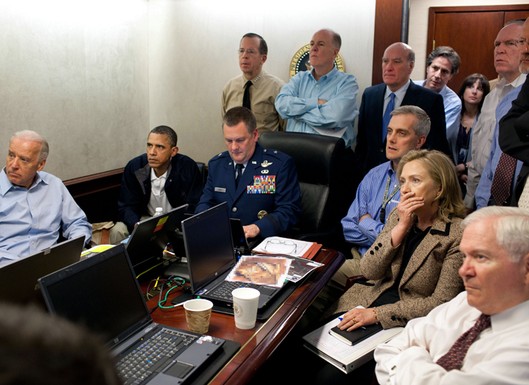
Hillary Clinton's expression, right hand clasped over her mouth in astonishment, is largely responsible for making the above photo iconic--and, to at least one newspaper, sexually suggestive.
In the photo, President Obama and his national security team are huddled around a conference table in the White House Situation Room, watching CIA director Leon Panetta narrate last Sunday's raid on Osama bin Laden's compound. The mood is clearly tense.
When Women's Wear Daily consulted a coterie of photo editors and designers about why the image is "destined to be one for the history books," Clinton was foremost in their responses.
"The Hillary Clinton expression is the one that holds the photograph fully," Time's photo director told the magazine. "You can see 10 years of tension and heartache and anger in Hillary's face," Conde Nast's Scott Dadich agreed.

OSAMA: Pakistani Newspapers.‏


It was with a sense of quiet resignation that Pakistan on Monday absorbed Barack Obama's announcement that Osama bin Laden had been killed in Abbottabad, a district that is a two-hour drive away from the federal capital.

The usually “conservative” media did not refer to his death as shahaadat (martyrdom), but used the word halaak (killed). Many media-watchers found this to be refreshing. “While reporting deaths of religious militants, Pakistani media – particularly, the mainstream vernacular print and electronic media – usually uses shaheed (martyr) or jaan bahaq (laid down life) unless they have been killed by the military.”

"Even in death, Osama haunts Pakistan," screamed a headline in Pakistani media which termed the US surgical strike deep inside the country killing Osama bin Laden was "something of an embarrassment" and said the "time for denial is over".

The newspapers, which carried bin Laden's death in front pages, highlighted the lack of clarity about Pakistan military's role in the US raid, a day after the al-Qaida chief was gunned down in a helicopter-borne operation 800 metres away from the Pakistan military academy near Abbottabad.
"Even in death, Osama haunts Pakistan," said the banner headline in The Express Tribune, while the Business Recorder headlined its report "Liquidated".
In their editorials, the dailies called on the country to reflect on issues raised by the dramatic pre-dawn swoop by US forces on a large compound near the garrison city of Abbottabad that killed bin Laden, whose presence in Pakistan had been denied for years by the country's top leadership.
The US raid in Abbottabad had raised "a slew of questions about the level of cooperation with Pakistani intelligence and the military", the Dawn said.
"Were they taken into confidence? If so, at what point? Were they consulted or simply informed? Did they play a role in the operation?" the newspaper questioned.
"As for Pakistan, the time for denial is over. Osama bin Laden was not holed up in a cave in the tribal agencies. He was living in a large house surrounded by high walls topped with barbed wire in a garrison town housing a military academy," the editorial said.
"The idea that the world's most wanted criminal was spending his days there unnoticed by Pakistani intelligence requires either suspension of disbelief or the conclusion that the authorities are guilty of a massive intelligence failure. Both hypotheses are disturbing," it concluded.
The News daily said in an editorial titled "The fall of Osama" that certainly, "the astonishing manner in which the operation that resulted in bin Laden's death...leaves us all gasping in astonishment,"
The newspaper said Pakistan's failure to detect the "presence of the world's most wanted man here is shocking" and noted there was "lack of clarity as to what role, if any, our security and intelligence apparatus played in the whole affair".
"Many questions still hang in the air...For Islamabad, the whole business is something of an embarrassment. Despite years of fervent denial, bin Laden has been found on Pakistani soil. And now that the brazen US action in Abbottabad has happened, there may be other attempts to go after key militant figures in different urban centres," The News said.
The Express Tribune, in its editorial "Osama bin Laden and after", noted that the US had reportedly not told Pakistan of the identity of the "high value" target till just before the operation in Abbottabad began.
"If all of this is true - and it really seems fantastical on the face of it that something like this could have happened without Pakistan's tacit or overt approval/assistance - then the obvious question arises that what was Osama bin Laden doing in Abbottabad, a garrison town, in a house that was a stone's throw from the Pakistan Military Academy."
It questioned how the al-Qaida chief's presence was not detected by Pakistani intelligence agencies, especially as Abbottabad "is not some remote, relatively inaccessible location" in the tribal areas.
It also noted that Abbottabad is close to Mansehra "where, right after the Mumbai attacks, a training camp run ostensibly by the Lashkar-e-Taiba was shut down by the Pakistani authorities".
The Tribune said many questions would be asked about bin Laden being present in the country.
"In all of this, one thing is clear: Pakistan should have hunted the man down on its own, because America is not the only country that has suffered at the hands of al-Qaida and its allied jihadi outfits," it said.
The influential Dawn newspaper, in its editorial, said an era had ended with the killing of bin Laden, whose 9/11 terror attacks in the US had "transformed Pakistan and Afghanistan, dragging them into ideological divides and violence".

Monday, May 2, 2011


Zardari on hit-list: Taliban vows to avenge Osama's death
The Pakistani Taliban today warned that they would target Pakistan and the US to avenge the killing of al-Qaeda chief Osama bin Laden by US special forces in a raid near the garrison city of Abbottabad.
In an audio message issued to the Pakistani media from an undisclosed location, Tehrik-e-Taliban Pakistan spokesman Ahsanullah Ahsan confirmed the death of bin Laden, the world's most wanted man, and said his group would take revenge for his killing.
"We will avenge the killing of Osama bin Laden. Pakistan is now the first target of the Taliban and the US the second," said Ahsan, who spoke in Pashto.
He warned that Pakistan's leaders were on the Taliban's hit list.
In telephone calls to journalists in northwest Pakistan shortly after the US announced the killing of bin Laden yesterday, Ahsan warned that top Pakistani leaders, including President Asif Ali Zardari, and the Pakistan Army would be the "first targets" of his group.
Ahsan also said in his audio message that the US should not be jubilant about killing bin Laden as American authorities took 10 years to find the al-Qaeda chief.
"We killed former Prime Minister Benazir Bhutto (in 2007). After three months of planning, we sent a suicide bomber to kill her... We completed our objective in three months while the US was trailing Osama bin Laden for 10 years," he said.
US officials have often said that the Pakistani Taliban, led by Hakimullah Mehsud, has close ties to al-Qaeda.
Both groups have safe havens in Pakistan's tribal belt bordering Afghanistan, the American administration has said.


US forces kill Osama bin Laden in Pakistan

'Justice has been done,' Obama says; 9/11 mastermind is buried at sea after gunbattle


Key details:

  • Al-Qaida leader killed in operation led by Navy SEALS, Special Ops
  • His compound was located close to Pakistan army regiment
  • Obama says 'justice has been done'
  • Security ramped up in U.S. cities
  • Former President Bush hails 'momentous achievement'

Osama bin Laden, the mastermind behind the Sept. 11, 2001, terror attacks that killed thousands of Americans, was slain in his luxury hideout in Pakistan early Monday in a firefight with U.S. forces, ending a manhunt that spanned a frustrating decade.

"Justice has been done," President Barack Obama declared late Monday as crowds formed outside the White House to celebrate. Many sang "The Star-Spangled Banner" and "We Are the Champions."

Hundreds where the twin towers that once stood as symbols of American economic power were brought down by bin Laden's hijackers 10 years ago.

The raid
The operation Sunday went smoothly except for a helicopter landing that was not part of the original plan. The choppers were only intended to hover over the scene, but due to a technical malfunction, one of them landed or fell — "not a crash," the official said — so the military dispatched a third "emergency" helicopter to the scene.

"This operation was a surgical raid by a small team designed to minimize collateral damage. Our team was on the compound for under 40 minutes and did not encounter any local authorities."

Bin Laden himself participated in the ensuing firefight, the officials suggested.

"Bin laden was killed in a firefight as our operators came onto the compound," an official said.

Official: Bin Laden’s buried at sea after deadly showdown with US forces


WASHINGTON — A U.S. official says Osama bin Laden has been buried at sea.After bin Laden was killed in a raid by U.S. forces in Pakistan, senior administration officials said the body would be handled according to Islamic practice and tradition. That practice calls for the body to be buried within 24 hours, the official said. Finding a country willing to accept the remains of the world’s most wanted terrorist would have been difficult, the official said. So the U.S. decided to bury him at sea.

Osama bin Laden, 54, who was born into Saudi riches, only to end up leading a self declared holy war against the United States as head of one of the most ruthless, far-flung terrorist networks in history, died Sunday in the manner he had often predicted: in a strike by U.S. forces.

As the founder of al-Qaeda, bin Laden demonstrated the power and global reach of a terrorism campaign rooted in centuries-old Islamic beliefs and skilled in modern-day technologies. The militants he inspired have proved surprisingly resilient, and the organization he established continues to pose a substantial threat to U.S. interests overseas and at home.

Although bin Laden was able to elude an intense U.S. manhunt for years, al-Qaeda’s ranks were increasingly weakened by the capture or killing of senior operatives.

Further, his violent mission never came close to achieving its central aims of pushing U.S. troops out of the Middle East and replacing U.S.-backed Arab governments from Cairo to Riyadh with strict Islamic rule.

Little in bin Laden’s privileged upbringing as a scion of a wealthy Saudi Arabian family suggested he would become the self-anointed champion of Islamist extremism and the world's most wanted man, with a $25 million bounty for his capture, dead or alive.

Though first exposed to fundamentalist religious teachings during his teenage years, he was as a youth much more pious than political — a tall, shy figure who aspired with his many siblings to join the giant bin Laden family construction business.

His experience in the 1980s leading an Arab contingent against the Soviet occupation of Afghanistan engendered a fierce sense of militancy.

The subsequent arrival of U.S. troops in the Middle East, initially deployed in 1990 to oust Iraqi forces from Kuwait, served to focus bin Laden’s ire on a view of the United States as a domineering, corrosive threat to Islam.

A shrewd propagandist with an understated though commanding presence, he showed particular talent in bringing together terrorist elements under the umbrella of his loose movement.

His brazenness in taking on the United States struck a popular chord, and his ability to wrap himself in the imagery of the prophet Muhammad carried deep resonance in the Muslim world. His deft use of international media helped magnify his message of murderous defiance against Western influences and restoration of a long-ago Islamic order.

The U.S. government first identified bin Laden as a threat in the mid-1990s, linking him to several deadly attacks, including suicide missions against U.S. embassies in Kenya and Tanzania in 1998 and the USS Cole in Yemen in 2000.

By then, his siblings had shunned him, formally revoking his shares in the family’s lucrative corporate enterprises. The Saudi government had stripped him of his citizenship, and he had gone into exile in Sudan and, later, Afghanistan.

It was his shaping and financing of the plot to crash hijacked U.S. airliners into the World Trade Center and the Pentagon on Sept. 11, 2001, that finally galvanized U.S. forces against him in what President George W. Bush called the “first war of the 21st century.” Bin Laden made clear at the time that civilians would not be spared in his bloody campaign of indiscriminate killing
.