Tuesday, April 13, 2010

A reason to smile: Nigar
In Pakistan, we often make the mistake of thinking that the phenomenon of women breaking stereotypes and conquering uncharted terrain is a recent one.

Nigar is Pakistan’s first female cartoonist. She started her illustrious career with a bold decision – in 1967, she switched out of a pre-med degree to study fine arts. As a result, she was drawing comics when no teachers or coursework in this artistic format were available. The situation was so dire at the time that when Nigar came to work at the Karachi Arts Council, she found little to occupy her. It was then that Ali Imam, then director of the council, made her draw one cartoon a day to keep her busy. She has never looked back from that experience.

With a fondness in her voice, Nigar narrates how she got her first break, drawing cartoons for the Sun newspaper. Her character, Gogi, an urban Pakistani woman struggling with her frailties in the context of gender-discriminate social norms was such a hit that soon the Morning News, Dawn, The Mirror, and the Daily News began featuring her work.
After publishing countless cartoons for various publications and nine comic books and receiving many national and international accolades, Nigar still inspires many budding artists who feel limited by their choices in an environment that does not support creativity.

Monday, April 12, 2010

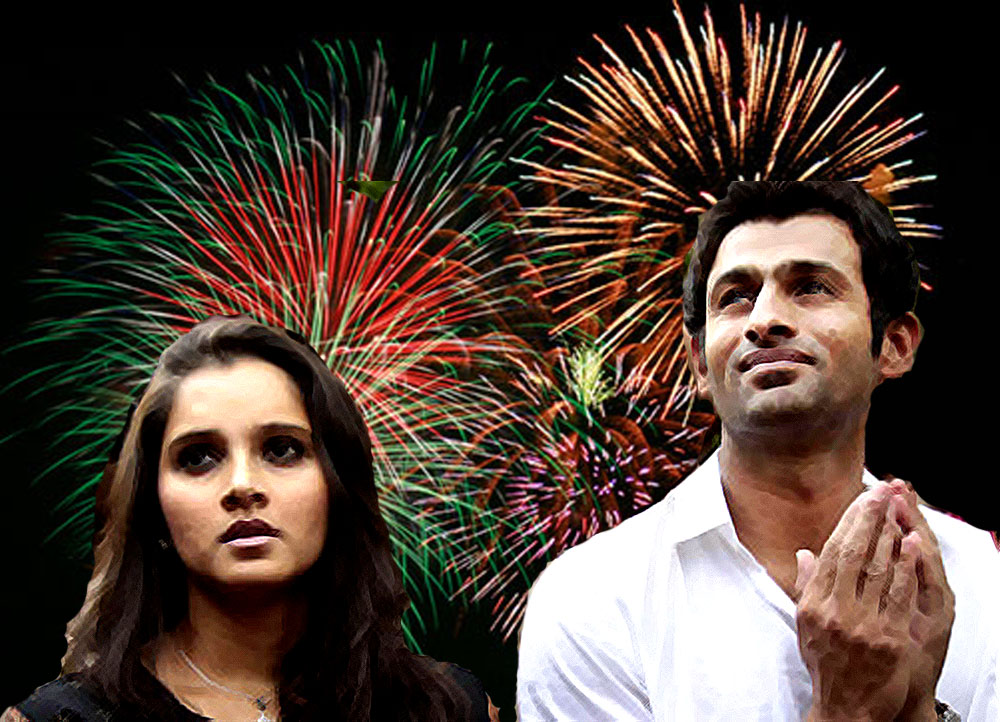
Sania Mirza and Shoaib Malik marriage goes viral on internet. Sania Mirza and Shoaib Malik’s marriage has remained the most talked about marriage in Pakistan & India during the last several years. The marriage ceremonies of even wealthiest men and women don’t get the sort of publicity that this marriage has attracted.
Shoaib-Sania nikkah solemnized
Sania Mirza weds Shoaib Malik Today
Tennis star Sania Mirza married Pakistani cricketer Shoaib Malik on Monday, after a romance that saw the groom forced to get a messy divorce from his first wife days before the wedding.
The two wed at a plush hotel in Hyderabad, hometown of Mirza, the poster girl of Indian tennis on whom ride millions of rupees in brand endorsements.
"The nikah (marriage) has been completed, it has just got over. Please pray for the couple," Rucha Naik, a spokeswoman for Mirza, told reporters waiting outside the hotel.
Marriages between people from India and Pakistan, nuclear-armed rivals who have fought three wars, are rare. But this wedding transfixed the two nations as a dramatic revelation came to the fore days after Mirza and Malik said they were marrying.
A Hyderabad woman named Ayesha Siddiqui complained to police, saying she and Malik married in 2002 and that he could not marry again without divorcing her.
Police seized Malik's passport and questioned him after the former Pakistani captain denied knowing the woman.
The two sides repeatedly appeared before TV cameras to refute each other's claims as Muslim clerics weighed into the row.
But last week Malik signed divorce papers in an implicit acknowledgement of his marriage to Siddiqui, who then withdrew her complaint.
Mirza is the first Indian to win a WTA tour event in 2005. Despite initial promise, she now ranks at 89, hamstrung mostly by injuries.
Malik, 28, is fighting a year-long ban by the Pakistan Cricket Board for poor performance and indiscipline.
The couple will settle in Dubai.

Mirza, 23, wore a red embroidered sari from her mother's wedding trousseau 25 years ago. The groom, accompanied by relatives from Pakistan, wore a long black tunic.

Saturday, April 10, 2010

Friday, April 9, 2010

maulavis upset:
UP ulema chastise Sania's 'forward' behaviour
Adding to Sania Mirza's pre-marital blues come scathing chastisement from ulema, including Darul Uloom Deoband. The "objectionably forward behaviour'' displayed by the India's ace tennis player has obviously not gone down well with the Islamic seminary --their advise to Saina and her would-be groom is to behave in a restrained manner and not to flout guidelines set by the Holy Book till they are actually declared husband and wife.
In a statement issued on Thursday, Mufti Ashraf Farooqui from the Fatwa department of Deoband, roundly lambasted the couple for their "unacceptable behaviour''. The kind of proximity shared publicly by Sania Mirza and Shoaib before their marriage is un-Islamic and therefore "haram'', the mufti ruled. "It is against the tenets of religion and also culture which has always put high premium on restraint.'' Islam, the mufti ruled, unequivocally prohibits free mixing between opposite sex. The kind of intimacy Saina has developed -- they are living under the same roof -- is highly objectionable. "Nikah ke pahle tanhai mein milna, batein karna, ghoomna-phirna, Islam mein haram hai (Islam bans meeting in isolation, going around and talking before marriage),'' he said. The couple, therefore, need to rectify their behaviour, he said. The unbridled show of intimacy has upset not only the maulavis, but also the members of All-India Muslim Women Personal Law Board. Shaista Amber, the president of the body, termed the free-for-all-shows staged by the couple, particularly the "bepurda and behijab Saina'' totally against the spirits of Shariat. Islamic rules apply to everyone, from a rickshaw-puller to a celebrity, and they are definitely guilty of flouting all that is scared in Islam, she said. Bride and groom, as per Islamic practices, must stay separately and if living under the same roof, they must occupy different wings or rooms, said Naib Imam of Lucknow Maulana Khalid Rasheed Firangimahali. Going by the reports, this is not being followed in Mirza household. Shoaib must move out and find himself another residence, he said. The maulana also expressed displeasure at the obvious disregard shown to Islamic tenets by the celebrity couple. Their `nikah' could be valid but the behaviour leading up to is totally un-Islamic, he said.
=====================
Sania Mirza to wed Shoaib Malik today
In yet another surprising twist to the Sania Mirza-Shoaib Malik affair, the Indian tennis star has decided to marry the Pakistani cricketer today instead of the previously decided date of April 15.
Quazi Azmatullah Jaffri of Dar-Ul-Qazzat confirmed that the nikah will be performed after evening prayers in Hyderabad today.
The couple had earlier announced that they would tie the knot on April 15 but as it turns out that date has been set for their reception ceremony to be attended by about about 500 guests at the Taj Krishna hotel.
Ever since they announced their wedding, the couple had been hounded by the media over Malik's first marriage. Another Hyderabad girl Ayesha Siddiqui had alleged that Malik married her over the phone before dumping her without a divorce due to her weight problems.
Shoaib initially denied the allegations and claimed that Siddiqui duped him into a phone marriage by sending photographs of a different woman. The all-rounder, however, finally agreed to divorce her after being pressurised by community leaders.
Siddiqui had also filed an FIR against Shoaib alleging fraud and criminal intimidation which led to the cricketer'spassport being confiscated by the police.
The FIRs have been withdrawn after Malik agreed to divorce Ayesha and Shaoib is likely to get back his passport before the reception if he applies to the court today.
"As far as police are concerned, the case is closed. Malik has to apply to the court and get back his passport," Narasimha Reddy additional commissioner of police told PTI.
He said some administrative procedures have to be followed.

"We received requisition from Siddiquis. Now they can settle the matter in Lok Adalat," Reddy said.

Thursday, April 8, 2010

Wednesday, April 7, 2010

Sani Pakistani: A Tribute.


The media and the marriage
....so here it goes
It has been over a week since a private television channel broke the story about Pakistan cricketer Shoaib Malik being engaged to marry Indian tennis player Sania Mirza, and the media seems to have only gotten into full swing as the milky plot thickens into a curdling, sensationally sweet kheer.
First of all, what exceptional journalism by the news media. Seriously, hounding Malik for scandalous stories day and night is no easy task, even for one of the country’s biggest news networks. Of course, the story is so great that it in fact becomes its own reward, where news networks and media outlets get to take a gear-shift from terror/despair to celebrity/scandal. It helps lighten the mood, and sugary treats are often good to keep the national news digestion metabolism going.
Seriously, it seems like celebrity marriage scandals conveniently pop up every now and then. It wasn’t too long ago when the media was all over Meera’s supposed wedding, and boy did the news channels have a field day with that one. The formula is so simple: all you have to do is send out a mob of camera men and reporters to ask annoying questions of every single relation of the scandalous celebrity in question, and then parade that on the airwaves all day and all night.
Though I doubt the broadcasters knew the exact magnitude of what they were about to uncover in the current celebrity scandal episode of Shoaib and Sania’s engagement. What would have otherwise been a day’s worth of news with some possible runtime on the little ticker on the bottom turned out to be a full-fledged, high-risk, cross-border drama packed full of entertainment and scandal. Once the media-hype flared, the conflagration became uncontrollable on both sides of the border, with everyone ranging from politicians to sports professionals commenting on the spectacle. Hell, the media even went down to Shoaib’s hometown to dig up his chubby childhood friend who rambled on incessantly about how great the whole thing is, in what would probably be the only airtime he gets in his entire life.
Speaking of getting airtime, this latest media blitz has given old washed up celebrities like Adnan Sami new ideas on how to get some publicity going for them. The previously highly-controversial singer has been prompted to announce his plans to wed his third (yes, one, two, three… third) wife. He’s also offered to do a duet song with Nawaz Sharif. I don’t know what to expect other than a rap mash-up of Kabhi Nahin and Thori Si Lift Kara De. Of course, this bait was lapped up in no time by the news channels, which started running it in the headlines juxtaposed with Shoaib’s convoluted wedding, making half of the top stories about messed up celebrity weddings.
The media’s salivating over the Shoaib-Sania story is understandable, given that it has all the elements of a Bollywood extravaganza. The strapping young hero Shoaib Malik whose career had just taken a turn for the worst finds sanctuary in love with a sporting celebrity from the other side of the border. Of course, if the cross-border affair isn’t controversial/scandalous already, it gets exacerbated beyond proportion when the hero’s
jealous ex-telephonic affair decides to make an appearance in the media spotlight. And of course the media was more than happy to grant the other woman, Ayesha Siddiqui, the stage to hurl insults at the embattled Shoaib. What further drama will ensue over the fact that young Ayesha used a stand-in, a mysterious woman from Saudi Arabia, to entice Shoaib, one can only wait and see.
Moreover, what better villain could any Bollywood-type plot ask for than Bal Thakray himself making outlandish statements about the patriotism and honour of the beloved heroine of this affair. Heck, now even the Hyderabad police has become involved with a case registered against Shoaib by the jealous ex. Now all we need is for Shahid Kapoor to agree to play Shoaib Malik in a Bollywood blockbuster based on true events. This will make millions in theatres once its released.
Indeed, the plot hasn’t even materialised yet, and the media conglomerate has already made millions off it. If the story wasn’t already being milked for everything it was worth, someone had to get hold of a two-second,
cell-phone video clip of Shoaib caught at a dance practice through a crack in a door, and that clip has been run on repeat, cut, spliced, mixed with cheap songs, four-way psychedelic split, black-and-white romanticised, you name it; all the post-production effects you can think of, in all possible combinations. It might just be nominated for the most-played clip in Pakistan’s free media history.
Okay, maybe I’m going a little over the top with this media bashing. I mean, the media works so hard day and night reporting on terrorism and the ills of Zardari, they deserve a break, right? Right! But when you get bombarded by videos, commentary, criticism, analysis, and debate over Shoaib and Sania’s wedding in the form of ‘Breaking News’ bulletins, please forgive me for wanting to shoot myself in the mouth. It is as if there’s no bigger news on the whole planet than Shoaib’s plans to marry.
The country is in an indefinite state of turmoil, there’s no water or electricity, we’re constantly on the verge of war on both our borders, and this is what you get in the news, continuously, for a whole week? Why is the great free media going after cheap celebrity gossip when it could be putting its great investigative journalistic resources towards greater goals, such as getting hold of bank account details of corrupt politicians, or maybe some real covert coverage on the things the ISPR doesn’t want embedded reporters to be snooping around in. If that’s too much to ask, and if the media must get their fill of strange wedding arrangements, then the least they can do as a compromise is look into all the mainstream politicians who have strange polygamous dealings going around.
At the end of the day, this whole absurd ordeal just tells us something about how the media works, and something about ourselves. Sadly, we as a media consumerist society are happy just feeding off cheap celebrity gossip, giving the media that cherished airtime over which they compete so vehemently.
And we, the biggest critics of the West, should wake up and take a long hard inward look before we criticise the apathetic and disinterested American electorate for being too caught up with television-news soap operas in the form of the OJ Simpson trial or the Monica Lewinsky affair to pay attention to important issues such as Israel-Palestine and the wars in Iraq and Afghanistan. At the end of the day, we’re feeding on the same kind of media-manufactured cheap thrills. And it seems we could gorge on this useless information until we’re stuffed, and then slip into a nice comfortable… sleep.


Maliks reach deal; Shoaib signs divorce

The ordeal of families of Ayesha Siddiqui and Shoaib Malik came to an end when both the families reached a compromise late on Tuesday night with the divorce paper signed by Shoaib Malik handed to Siddiquis.
According to the deal, Ayesha Siddiqui, the first wife of Shoaib Malik withdrew the FIR filed against him, whereas, Shoaib has signed the divorce paper.
No money was exchanged when deal was signed.
A number of Muslim community leaders brokered the deal between the two sides, negotiations for which started last night and concluded this morning. Abid Rasool Khan, a Congress leader and also a common friend to both the families, said many Muslim leaders were involved in working out the compromise.
Addressing the media, Abid Rasool Khan said, “The community especially elders were upset at the muck throwing, the allegations and counter allegations, the inconsistencies in the statements. Things were going bad to worse; there was a lot of pressure from community on both families that this should not be done this way. That is why we got involved. We negotiated whole of last night and by the grace of Allah have managed to hammer out an honourable solution for both parties. We have not taken any sides. The matter has been resolved peacefully.”


He added, “There has been no money involved except the nominal amount required to be given to Ayesha for maintenance at the rate of 5,000 per month for 3 months, as per Islamic Law.”

Saturday, April 3, 2010

Ayesha Siddiqui gets public sympathy in Pakistan
Shoaib Malik claims to have been cheated and deceived by her but public sympathy in Pakistan seems to be with his alleged first wife Ayesha Siddiqui if an opinion poll conducted by a television channel here is anything to go by.
A show on 'Geo TV' on Shoaib's much-anticipated wedding with Indian tennis star Sania Mirza put a question to the viewers, asking "Who is in the wrong in the Shoaib Malik and Ayesha Siddiqui controversy."
During the show itself 62 per cent of the polled votes blamed Malik and only 38 per cent said Ayesha was in the wrong.
Since Ayesha broke her silence and produced the Nikahnama of her marriage with Shoaib, there has been widespread sympathy for her from the Pakistani people particularly after the press conference held by her father and mother on Friday night.

Shoaib clears air, says he never met Ayesha
Embroiled in a controversy over his alleged first marriage, former Pakistan cricket captain Shoaib Malik has claimed that he has never met Ayesha Siddiqui, who claims to be his first wife.
Speaking to The Times of India, he said, "This relationship started on the telephone, in the year 2001. I was in Sharjah at that time, with the Pakistan cricket team. She telephoned me, introduced herself as Ayesha, and told me that she was a fan of mine, who lived in Saudi Arabia. That's how we got talking."
He says that the Siddiquis cheated him by showing some other girl's photograph as Ayesha's.
Since the news of Sania and Shoaib's marriage broke, the controversy has thickened with both Ayesha's and Shoaib's family arguing and counter-arguing about the whole affair.
Shoaib flew to Hyderabad on Friday night to meet Sania and prepare for his marriage with the tennis star.
Meanwhile, Sania Mirza backed Shoaib Malik on social networking site Twitter saying that she and her family know the truth.
The passion for Bhutto

The majority of Muslims in Pakistan are ensconced in the popular Barelvi creed of Islam that is the mainstay of Muslims in the subcontinent. It reassures the enshrinement of the traditional Sufism that prevailed due to a long period of interaction between Islam and the esoteric strains of Hinduism and other faiths of India.

‘Folk’ Islam became the dominating creed of the rural peasant, the urban proletariat and the semi-urban petty-bourgeoisie. It incorporated the anti-clergy elements of Sufism, and a more relaxed fiqh, fusing these with accommodating forms of worship and the concept of overt religious reverence of people it considered divine. The result was a sub-continental Muslim ethos that was socially tolerant and repulsed by the puritan dogma.

Though agrarian in its worldview, ‘folk’ Islam did not negatively react to modern Islamic reform initiated by rationalists like Syed Ahmed Khan, and consequently (by the 1960s), it became the chosen expression of populist (secular) politics in Pakistan. The Pakistan People’s Party (PPP) became the first Pakistani political party to set the tone of its rhetoric according to the populist imagery of ‘folk’ Islam, in the process managing to attract the urban working classes and the rural peasantry towards its social-democratic programme.

Not only did the PPP chairman, Zulfikar Ali Bhutto, become one of the first major Pakistani political figures to start being seen indulging in rituals associated with ‘folk’ Islam (such as visiting Sufi shrines), PPP rallies too started radiating an aura of the colourful activity found at many Sufi shrines. The 1970s in Pakistan thus became an era of populist extroversion.

With ‘folk’ Islam adopted as a populist political expression by the ruling PPP, this form of expression eventually became the tool that culturally connected the country’s secular political parties with the spiritual and political moorings of the working classes and the peasants.

The cultural synthesis emerging from such a connection was one of the reasons behind Bhutto’s image, graduating from being that of a ‘brave patriot’ (1967-68), to becoming a people’s messiah (1970s) and the embodiment of a Sufi saint posthumously.

The ZAB regime was a vibrant mix of rural and urban populism (such as through the promotion of folk and proletariat art and music), and of modern bourgeois liberalism that helped urban society maintain a liberal aura. Night-clubs, horse racing and cinemas continued to thrive; religiosity largely remained a private matter, or manifest itself in a display of passion at shrines through dhamal, qawali, etc.

However, lurking within this mix was also an awkward anomaly. As the popular variation of Islam in Pakistan peaked in the 1970s, the modern variation (tied to the Aligarh thought) started to erode when things started to change within some state institutions after the 1971 East Pakistan debacle. A move was seen afoot in the army towards puritanical strain of Islam, especially those advocated by renowned Islamic scholar and the Jamaat-i-Islami (JI) chief, Abul Ala Maududi.

The JI was an early advocate of what came to be known as Political Islam. It first emerged as an opponent of secular/socialist Muslim nationalism in the 1950s and 1960s and was also opposed to the more populist strains of the faith. The JI was eventually successful in converting a sizable section of the urban middleclass to its cause after the former stopped resonating with the modern, reformist tradition of Syed Ahmed Khan. The populist ‘folk’ Islam they began to associate with ‘Bhuttoism’ or a ‘vulgar’ populism, supposedly aimed at undoing the hold on society of bourgeois politics and economics.

Thus, the urban bourgeoisie and the petty-bourgeoisie became the main players against the Bhutto regime during the 1977 PNA movement, led by the JI and its allies. But it wasn’t until the arrival of the Ziaul Haq dictatorship and the anti-Soviet Afghan Jihad that political Islam managed to find state approval.

As the US and Saudi Arabia pumped in millions of dollars of aid for the ‘jihad’, the more aggressive and puritanical strains of Islam that were largely alien to the region’s Muslims began finding official sanction as well. But in spite of the rapid proliferation of the jihadi mindset and penetration of puritanical Islam in the workings of society that Zia initiated, Bhutto is still remembered as an icon in the devotional sense of loyalty to the culture of ‘folk’ Islam.

Thus, it is not surprising that his death is not seen by his supporters as martyrdom gained through the puritanical concept of ‘jihad’ against an infidel. Instead, his execution by the Zia dictatorship is embroiled in the kind of folk imagery that would leave the Islamists cringing. It is remembered more as a murder of a modern Sufi saint who danced to the gallows in defiance of a usurper and his malicious, scheming team of puritan clerics.