Wednesday, June 16, 2010


War in Kyrgyzstan: what is causing the violence?

When the five former Soviet republics of central Asia gained their independence with the breakup of the USSR there were hopes that Kyrgyzstan might achieve a semblance of responsible rule.This small country of 5.5 million people had a relatively developed civil society and free press. But hopes were dashed under Askar Akayev, a president accused by the opposition of nepotism, corruption and growing authoritarianism.

Akayev was succeeded by Kurmanbek Bakiyev in the Tulip revolution in 2005. Bakiyev concentrated power within his family and allegedly plundered state funds and secured lucrative contracts for friends and relatives. Human rights abuses were widespread as dissidents were killed or disappeared. Journalists were muzzled and often detained, and the presidential elections last July were judged by international observers as having been rigged.

In April, it was Bakiyev's turn to suffer the wrath of the people. A rise in utility prices proved to be the final straw and a swift, violent, rebellion broke out in the Kyrgyz capital, Bishkek. In less than two days, 85 people were killed, the centre of the capital was looted and Bakiyev was gone.

Kyrgyzstan dropped from the headlines as a provisional government, led by Roza Otunbayeva, a former minister under Bakiyev, took over.

As the International Crisis Group thinktank pointed out in April the provisional government turned out to be weak. Its 13 members largely failed to present themselves as a cohesive or coherent administration, or be transparent about their activities at a time of great anxiety and uncertainty. There was a lack of common ideology or strategy, as well as signs of internal discord. The decision to postpone new elections, promised for October, until the end of 2011, did little to inspire public confidence.

Analysts say a power vacuum since April has allowed opportunists to fan political tension for their own ends.

The absence of strong government "has provided opportunities for clans to exploit social tension", said James Nixey, a Russia expert at the Chatham House thinktank, although he argued that the tension within the country stemmed more from poverty and social exclusion and had more of an intra-ethnic than inter-ethnic nature.

Otunbayeva has blamed Bakiyev, who has fled to Belarus, for instigating the unrest in southern Kyrgyzstan, where clashes between the two main Kyrgyz ethnic groups – the Uzbeks and the Kyrgyz people – in the second largest city of Osh have left about 120 people dead. Bakiyev said that claims that he ordered the disturbances were shameless lies.

Uzbeks make up 15% of Kyrgyzstan's 5.5 million population, but in the south, where the violence has been, their numbers rival those of ethnic Kyrgyz.

As tens of thousands of Uzbeks flee to the border and await entry into Uzbekistan, there are fears among other central Asian nations that the violence could spread. It will also worry the US, which operates a military base near Bishkek, supplying troops in Afghanistan. The US is having to use Bucharest, Romania, as a transit point for troops flying home from Afghanistan because of instability in Kyrgyzstan.

In its gloomy report in April, the International Crisis Group warned that the collapse of the Bakiyev regime was a case study of the risks facing authoritarianism in central Asia, where Kazakhstan, Tajikistan, Turkmenistan, Uzbekistan and Kyrgyzstan have been governed by strongmen in the old Soviet mould.

"What happened in Kyrgyzstan in terms of corruption and repression is already taking place in several other countries," said the ICG. "What happened in Bishkek in April 2010 could happen in most of its neighbours. It could indeed be much worse."

But outside powers, particularly Russia and China, who covet the region's extensive natural resources of natural gas and hydro power, and the US, with its base in Kyrgyzstan, show little interest in fostering more responsible rule.

Saturday, June 12, 2010


Pakistan has been blessed with many amazing women whose stories have been largely untold. Shahla Haeri wrote about some of them involved in the social sphere in her book “No Shame for the Sun“. OPEN’s chapters have also held conferences and forums highlighting the role of Pakistani American women in the US. In the recent years three Pakistani women have defied all odds and achieved remarkable success in achieving some of the highest goals typically associated with men. These achievements are specially significant taking into account their economic and geographic origins.

Three Heroines of Pakistan
Maria Toor: Pakistani Woman Squash champion from South Waziristan

Maria is the Pakistan Woman Squash champion and Seventy Second in the World. What is remarkable is that she comes from WANA South Waziristan, the home of Pakistani Taleban. Her parents are from a poor background and she did not even pick up a squash racket till the age of twelve. Her meteoric rise in squash is amazing as she has achieved this with little to no resources. In listening to her in the attached video you can get a sense of her passion for the game and the hurdles she had to overcome in order to get there. The other thing that struck me was her confidence in achieving pretty much what she put her mind to, including appearing in a Hollywood movie. With little to no education she has still found the time to learn English and appears comfortable in front of the camera.

Saira Amin: First female Sword of Honor Winner and Fighter Pilot from Peshawer

Saira not only graduated from one of the most rigorous air force academies in 2006, but also won the most coveted Sword of Honor. To achieve this you need to be the most outstanding cadet in all of the three areas of flying, academics and general military training. She belonged to only the second group of females to be inducted into the PAF. She had to outclass all her male colleagues in physically grueling training that included para jumping.
She has established that in a extremely male dominated domain of jet fighter pilots of one of the most demanding of air forces, a female can not only participate but even dominate.

Naseem Akhter: Fastest Woman in South Asia from Korangi.

Naseem Akhter caught the fancy of all of Pakistan when she beat Pramila Priyadarshan, the Sri Lankan favorite to win the gold medal in South Asian games in 2010. She hails from a poor family from Korangi area of Karachi. Her dedication to achieve her goal was captured in her statement that she gave after the event.
“I had forgotten the world for six months and trained really very, very hard under my coach Maqsood Ahmed to achieve this. It is a great moment for me to have brought glory to the country in my event.”
What really struck me in the photo is that she was wearing loose clothes and yet was only a second and half behind the fastest woman on the planet, Florence Griffith-Joyner. I can only wonder that with some training and more streamlined clothes what she can possibly achieve.
The theme that runs common in all the three stories is that none of these ladies let any excuse come between them and their goals. They managed the challenges with a supportive family structure. They exhibit all the same qualities that are needed to be a successful entrepreneur. They had to raise money, market their talents, fight the naysayers and excel in what they did with single minded focus.
To all these women, “Afreen” .

Friday, June 11, 2010


UK premier of film on Shaheed BB to be held on June 18th


LONDON: An award winning documentary on the life of former Prime Minister of Pakistan Mohtrama Benazir Bhutto will be screened across the UK from June 18.
Mara Pictures has secured the UK theatrical rights for Bhutto, a documentary chronicling the life of Benazir Bhutto, one of the most fascinating characters of the modern era.
The film will also been screened in various film festivals around the British capital in the next two months.
A Duane Daughman Film, Bhutto is co-directed by Johnny O Hara and had its world premiere at the 2010 Sundance Film Festival in the US . According to a press release received from Mara Production "the fast-paced film makes clear that Benazir Bhutto's life and reign of power were marked by contradictions and questions leading up to a final act of courage that resulted in her unsolved assassination at age 54. With her assassination she transcended politics, but left behind an historic legacy that will be debated for years to come. Bhutto received the "Special Jury Award for Outstanding Historical Documentary" at The Sonoma International Film Festival on April 20th, 2010 .
Regarding the release of the film, Executive Producer Glenn Aneni says, "Benazir Bhutto was a global leader of our times. We are confident her story will resonate with a worldwide audience."—Agencies

The first romantic hero of Pakistan

Friday marked the 28th death anniversary of Pakistani actor Syed Musa Raza, better known as Santosh Kumar, who passed away in 1982.

Kumar was born in 1925 in Lahore, and graduated from Osmania University Hyderabad. He was married to the renowned film actress Sabiha Khanum.

Kumar was active in Pakistani cinema during the 1950s and 60s and is considered to be the first romantic hero of Pakistan. His first film was “Ahensa” made in 1947 in India, and his first film in Pakistan was “Beli”.

Kumar also starred in the first ever silver jubilee Urdu film “Do Aansoo” in 1950. The very first Nigar Award for best actor was rewarded to Santosh Kumar for the film “Waada”.

“Shaam Dhalay” is the only movie he produced, directed and played the lead role.

Thursday, June 10, 2010


Pakistan stares at India, India at the world
When a senior security official here was asked why Pakistan was not developing long-range missiles, unlike in India, his answer revealed how
these two nuclear foes' geopolitical priorities may be diverging. "We don't have ambitions like India has, so we don't need to develop any further long-range missiles," he said. "Our missiles cover the entire India, so that's it." Indeed, India has raised eyebrows developing a new long-range missile with a capacity to hit most of China, a signal of how New Delhi's focus is tentatively moving away from an obsession with Pakistan to more global issues.
For decades, these two countries, which have gone to war three times since independence from Britain in 1947, have been synonymous with each other. Diplomats often like to talk of India-Pakistan as "hyphenated". But India is trying to move from that old beat, seduced more by its growing role in the global economy, its stellar growth and preoccupations with other security issues like China than dealing with what many Indians deride as a "failed state". Pakistan, meanwhile, often seems stuck in its obsession with India, mired in conspiracy theories, reflecting what critics say are decades-old fears that do little to bring regional stability. It's an imbalance that may help redefine how these nations reach for peace as well as create new risks, making an aspiring and globalised India more vulnerable to regional tension, while making Pakistan frustrated it is losing out to its neighbour. "India sees itself as playing a global role and looks at the region as a stepping stone for its aspirations," said Siddharth Varadarajan, strategic affairs editor for India's The Hindu. "Pakistan sees its ability to be noticed globally as related to its tensions with India." Take China. India is focused on boosting trade with China as part of its growing economic clout in Asia, while ensuring security over a disputed border. The two sides fought a brief but bloody border war in 1962. For Pakistan, China is simply source of diplomatic support and weapons to counter India. In Afghanistan, where both countries are seen in a proxy war for influence, Indian officials laud $1.2 billion aid as their ability to help bring regional stability through "soft power". Pakistan sees that as an effort to push it out and wants Indian aid scaled down. The imbalance has already produced tensions with the United States. Washington wants Pakistan to stop worrying about India and focus more on Taliban militants on its Afghan border. President Barack Obama hinted at frustration over Pakistan earlier this year when he said that (Pakistan's) "obsession with India as the mortal threat to Pakistan has been misguided... their biggest threat right now comes internally". Those kind of comments irk Pakistan, where policy makers still see India trying to gain the kind of influence it has in its other South Asian neighbours, like Nepal. "There are American efforts to persuade us to put troops on our Western border," said Riffat Hussein, chairman of the department of defence and strategic studies at Pakistan's Quaid-e-Azam University. "But no one here is fooled by that." The signing of a US civilian nuclear agreement with New Delhi is another source of tension. For New Delhi, the deal was about having access to the global nuclear power market. Islamabad looked on enviously as Prime Minister Manmohan Singh was feted in Washington. Its request afterwards for a similar deal has fallen on deaf ears. Pakistan worries India's new global role will make New Delhi more arrogant, with fewer incentives for peace when it feels too important to ignore. Those fears may be exaggerated. Singh, born in Pakistan before Partition in 1947, says India cannot really take its global place without peace in South Asia, with a second attack like Mumbai in 2008, which New Delhi blames on Pakistan-based militants, capable of derailing investor confidence in India's globalised economy. "The most cost-effective thing would be to engage Pakistan to improve the atmosphere to a point where you can reduce the possibility of another Mumbai," said a senior Indian official on condition of anonymity. "We know if we have to get on with it (India's global push), we have to move beyond Pakistan." India is far more vulnerable to economic shock from another major border build-up than it was in 2002, the year of the last major border crisis that saw the countries nearly go to war again. It still has most of its army on the border and steep rises in defence spending are also linked to a perceived Pakistan threat. So if India has one eye on global affairs, it always has the other on Pakistan, a fact not lost on Islamabad. While former Pakistan President Pervez Musharraf offered concessions over the disputed Kashmir region in a failed attempt to reach a peace deal with India a few years ago, his attempts to refocus away from an Indian threat may have proved just a blip. Under new army chief Ashfaq Kayani, one of the most powerful men in Pakistan where the civilian government is weak, there has been a return to talk of the Indian threat, a sign critics say of Pakistan's growing domestic problems. Conspiracy theories about India, often linked to the United States, abound in Pakistan. With growing militancy, attacks and social problems, they won't go away soon. "The more you lose on the economic front, on bad governance, the more you tend to externalise your problems and fears," said Imtiaz Gul, chairman of Centre for Research and Security Studies."Our conspiracy theories typify that tendency."
UN slaps new set of anti-nuke sanctions on Iran
World powers on Wednesday slapped new military and financial sanctions on Iran aiming to rein in its suspect nuclear program, but stressed the door remains open for talks.
A U.S.-drafted resolution was adopted by 12 votes in favour in the 15-member Security Council, with Lebanon abstaining and Brazil and Turkey voting against. Though swiftly hailed by the U.S., Britain and France, who co-sponsored the resolution, the move drew an immediate, scornful reaction from Iranian President Mahmoud Ahmadinejad.
"These resolutions are not worth a dime for the Iranian nation," said Ahmadinejad, who earlier threatened to suspend negotiations with six major powers if they were imposed.
Despite the backing of Russia and China, it was one of the least supported of the four Iran sanctions resolutions adopted at the UN. It expands an arms embargo and bars the country from sensitive activities like uranium mining. It authorizes states to conduct high-sea inspections of vessels believed to be ferrying banned items for Iran and adds 40 entities to a list of groups subject to travel restrictions and financial sanctions.
Tehran maintains its uranium-enrichment program is for peaceful civilian purposes, while the Western nations charge Iran is covertly seeking to develop nuclear weapons.

Monday, June 7, 2010


Cyclone ravages Sindh coast, spares Karachi

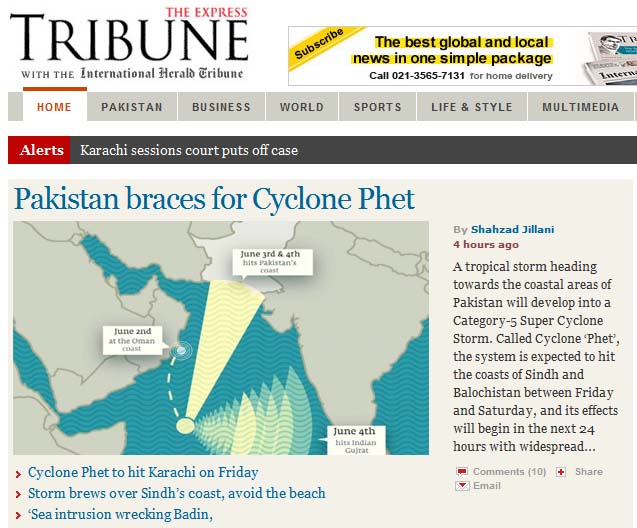
The much-dreaded Cyclone Phet, which kept Karachiites on tenterhooks for a week, entered the city coastline without so much as a whimper on Sunday evening before heading peacefully towards Thatta’s shoreline.
The waves on Karachi beach appeared a shade more turbulent than normal,while their height was not particularly high either. The roar and thunder of tidal waves, as had been feared, luckily did not batter the city known for its fragile infrastructure.

But while the city was spared the fury of the cyclone, nature’s tantrums exhibited themselves in the shape of torrential rains and winds starting from Saturday midnight and continuing intermittently on Sunday.

There were some places where there was water, agreed, overall the city was well able to cope with the rain. Thanks, I guess to the city government’s efforts and Mustufa Kamal for giving us the infrastructure.


Cyclone Phet roared past Karachi and tore across the coastal belt of Sindh on Sunday evening after about a week-long, 1,100km journey from the central Arabian Sea.
After lashing the Makran coast, the cyclone caused torrential rainfall in Karachi, Thatta, Badin, Hyderabad and adjoining areas.

Saturday, June 5, 2010


The sky’s the limit for Strings

Strings have endorsed several brands over the past decade, including Pepsi, Mobilink, Warid, Gibson guitars and they have now been chosen by Etihad Airways as brand ambassadors for the airline.
This deal shows how Strings has come full circle, given that the band’s first international tour was to Sharjah in 1992. Strings, which featured four band members then, had a mixed reaction from the expat audience in Sharjah. Bilal Maqsood and Faisal Kapadia laughingly told the now-defunct music website bandbaja.org in 2004 that they were not paid in full for the Sharjah concert from the tour promoters.
It is ironic – and a sign of how far the band has come that they are now endorsing the country’s national airline.
One of the key reasons for the airline choosing Strings is that the duo has a huge fan following in the Gulf amongst the desi community. Strings believe that the partnership will showcase a ‘softer’ side of Pakistan as well.
Maqsood said, “(Through this) the soft image of the country is being promoted. They have signed us up and we hope that we are able to match our music.”
When asked why Strings chose to partner with Etihad (the national airline of the United Arab Emirates) instead of the national flag carrier Pakistan International Airlines, Maqsood candidly remarked, “After all, our president lives in Dubai too.”
The band’s upcoming song, “Ab Khud Hi Kuch Karna Parega”, which features Atif Aslam, will focus on the current sociopolitical situation in the country. Maqsood said, “Last year, we were touring the US and when we came back, we had a reality check about the recent happenings in the country. We started writing the lyrics. We have worked with acclaimed Indian artists and this time round we thought someone from Pakistan (will fit in this) and what better name than Atif Aslam. So we recorded the song with him”

Wednesday, June 2, 2010


Karachi faces storm threat
Cyclone Phet approaching Karachi

The city poses the threat of storm during next 24 to 38 hours due to low atmospheric pressure in Arabian Sea, sources said Wednesday.
Cyclone Phet is likely to hit coastal areas of Karachi, Chief Meteorologist Arif Mehmood said on Wednesday.The cyclone moved to coastal areas of the city has intensified and now lies about 920 kilometers southwest of Karachi.Pakistan Navy and maritime security agencies put on high alert over cyclone threat.
At least 170 boats lost contact with control room as cyclone Phet is 900 kilometers away from Karachi.Navy helicopters have launched search operation for the missing fishermen. Meteorological Department warned fishermen against going to open sea and directed them to back up by today’s evening.According to Met Department, the cyclone is assuming more fury 900 kilometers to southwest of Karachi.

The ferocious hurricane would make landing at Pakistan’s coastline after 24 hours, as it is likely to force entry into Sindh coastal areas at night between Friday and Saturday.The fierce storm could unleash heavy downpours couple with gale-force winds in coastal areas of Sindh and Balochistan. Under the influence of tropical cyclone formed in Arabian Sea, Widespread rain associated with strong gusty winds is also expected in Sindh including Makran coast between Thursday to Saturday. PHET is a Thai word pronounced as Pet, meaning "Diamond".
Facebook Admits Censoring
Content in Pakistan

Facebook said on Tuesday that it has blocked users in Pakistan from accessing the 'Everybody Draw Mohammed Day !' page on its site out of respect for local standards and customs.

The Web site adopted a similar approach in India about a week ago when it was approached by Indian authorities in connection with the page, which has annoyed Muslims in many countries.

The indications are that Facebook may take a similar approach in Bangladesh, where the Web site has been blocked since Sunday.

"We have not removed the content from Facebook, although some pages may have been removed by their creators, but have only restricted access to it from certain countries out of respect for local rules," Facebook spokeswoman Debbie Frost wrote in an email on Tuesday.

The page invited users to post cartoons of Prophet Mohammed. Depictions of the Prophet are prohibited in some Muslim traditions.

On Monday a High Court in Lahore, Pakistan, ordered the removal of the block on the site that had been imposed on May 19.

Facebook has agreed to block the page in Pakistan, Naguibullah Malik, Pakistan's secretary of IT and telecom, said in a telephone interview on Monday.

The government will continue to block any offensive or derogatory content found on the Web, Malik said. Last week Pakistan lifted a total block on YouTube but said objectionable content on the web site will continue to be blocked.
After reviewing the situation, including information from the government of Pakistan that confirms Pakistani law in this area, Facebook decided to prevent the 'Everybody Draw Mohammed Day !' page from being viewed by users in Pakistan out of respect for local standards and customs, Frost said.

When dealing with user-generated content on global websites, there are occasions where content that is illegal in one country is not illegal in another, and may even be protected there by law, Facebook said. Most companies approach this issue by preventing certain content from being shown to users in the countries where it is illegal, and that is Facebook's approach, the company said.