Why doesn't the CM himself go somewhere else and let some competent person take charge of his office?
Thursday, August 25, 2011


Wednesday, August 24, 2011
Into Gaddafi's Bunker: The Rebels Overrun the Regime's Nerve Center
After hours of pounding battle on Tuesday, Libya's rebels smashed through the fortified perimeter of Muammar Gaddafi's compound in western Tripoli — the nerve center of the old regime — in the late afternoon, sending huge plumes of black smoke over the city, and perhaps dealing a fatal blow to Gaddafi's ability to cling to power. Footage apparently shot by rebels and aired on al-Jazeera showed armed rebels deep inside the Bab al-Aziziyah complex, rejoicing as they clambered upon the ruins of Gaddafi's old house, which was bombed by U.S. jets in 1986 and had been left by Gaddafi as a memorial to the West's evils.
This time, it was his rebel foes — and likely the last foes of his 42-year iron rule — who owned the territory. Explosions and what sounded like bursts of sniper fire resounded across the city from the complex throughout Tuesday, as rebels fought pitched battles, attempting to rout the last remaining fighters inside; the complex has been thought to be the sanctuary of Gaddafi's most hard-core fighters, some officials and close advisers and perhaps even the fugitive leader himself since the rebels stormed the capital on Sunday night. "We are liberating Libya from north to south," said Mahmoud Shammam, a spokesman for the rebels' National Transitional Council (NTC).


Yet even as Pentagon officials announced in Washington that the rebels appeared to control much of Libya's capital, the rebels' apparent military breakthrough was tempered by a setback earlier in the day, when Saif al-Islam Gaddafi — who had supposedly been in rebel custody — appeared as a free man, relaxed and smiling. His appearance in the early hours of Tuesday morning shattered the sense that the rebels' victory in Libya was at hand. Colonel Muammar Gaddafi's son was seen talking to the press while surrounded by supporters, raising concerns that the opposition might be struggling to knit together a cohesive government-in-waiting as it battles to finally crush Gaddafi's regime — as well as to hunt down the fugitive leader himself.
Invisible millions pay price of
statelessness
People rejected by countries they call home live in a shadowy limbo

Rejected by the countries they call home and denied the most basic of rights, stateless people live in a shadowy limbo — in the words of one such person, like being "between the earth and the sky."
Up to 15 million people are stateless, not recognized as nationals by any country. They are some of the most invisible people on the planet — an anonymity the United Nations hopes to lift when it launches an international campaign on Thursday to highlight their plight.
"One of the big problems we have is that this simply is not recognized as being a major issue globally," said Mark Manly, head of the stateless unit at the U.N. refugee agency UNHCR.
"In the media there's very little discussion, in universities there's very little research and in the U.N., until relatively recently, there hasn't been a lot of discussion either, so the effect of all that is that we still have major gaps in our knowledge," Manly told AlertNet, a humanitarian news service run by the Thomson Reuters Foundation.
Statelessness exacerbates poverty, creates social tensions, breaks up families and destroys children's futures. In some cases it can even fuel wars when disenfranchised people pick up weapons, as has happened in Ivory Coast and Democratic Republic of Congo.
Yet only 38 countries have signed the Convention on the Reduction of Statelessness which marks its 50th anniversary on Aug. 30.
One of the largest stateless groups is the Rohingyas, a Muslim people of South Asian descent refused citizenship by the Myanmar government. Hundreds of thousands are scattered throughout Bangladesh and Southeast Asia.
"There are no countries in this world for Rohingyas," said Kyaw Myint, 44, now living in Malaysia.
"Even animals can have peace of mind, but for the Rohingyas, because we are stateless, there is no peace of mind."
The effects vary by country, but typically stateless people are barred from education, healthcare and formal employment. They often can't start a business, own property, hold a driving license or open a bank account. They can't get married legally or travel abroad to work or visit family.
And they can't vote, which means they can't elect politicians who might be able to improve their lot.
Like many Bedouins (stateless Arabs) he is the descendant of nomadic Bedouin tribes which for centuries roamed freely across what is now Kuwait, Saudi Arabia, Syria, Jordan and Iraq.
Origins of statelessness
Probing the origins of statelessness is a lesson in world history and geography.
In many cases groups failed to be included when their countries became independent or drew up a new constitution. Many Kuwaiti Bedouins fell through the cracks when the country became independent in 1961, and the Roma in Europe have faced major problems in obtaining citizenship in the new countries that emerged after the break-up of Yugoslavia and Czechoslovakia.
A major factor behind statelessness is often racial or ethnic discrimination. Syria, for example, denationalized many Kurds in 1962 and Mauritania expelled around 75,000 Black Mauritanians in 1989.
Manly said the UNHCR is closely watching the succession of South Sudan. It is also scrutinizing the drafting of Nepal's new constitution amid fears millions could end up stateless.
A major factor behind statelessness is often racial or ethnic discrimination. Syria, for example, denationalized many Kurds in 1962 and Mauritania expelled around 75,000 Black Mauritanians in 1989.
Among the biggest sufferers are children. Open Society Foundations, the George Soros initiative which among other things tries to improve the lives of marginalized people, estimates around 5 million children globally are stateless, often simply because their parents are.
stateless persons born on your territory."
Kohn also urged governments to abolish citizenship laws which discriminate against women -- another big cause of statelessness. In at least 30 countries, mothers cannot pass nationality to their children. If the father is stateless, foreign or absent, the child usually ends up stateless.
Some hope
There have been some successes. For example, Sri Lanka has amended laws to allow Hill Tamils, descendants of immigrants from India, to obtain nationality. Ukraine has reintegrated Crimean Tartars deported to Central Asia under Soviet dictator Joseph Stalin.
"I think states are actually starting to recognize that there is a potential overlap between statelessness and national security issues," Kohn said.
"Obviously, if you disenfranchise people . that can lead to all sorts of social and potentially security issues, and in the worst cases civil war."
In December the UNHCR will host a ministerial-level meeting where countries will be asked to join the 1961 convention and make pledges to address specific concerns on their territory.
"It's an issue whose time has come," said Maureen Lynch, a consultant to the International Observatory on Statelessness.
Copyright 2011 Thomson Reuters. Click for restrictions.
72Share.Sponsored links
Friday, August 19, 2011
A land in the grip of fairytales If there is a single country across the planet endlessly obsessed with its origins – how it came to be created and on what basis – it has to be the Islamic Republic, Gen Kayani’s Fortress of Islam.
Nuke capability, Allah be praised, we have attained, and when in moments of patriotic emotion we sing its praises, we give the impression that nothing else matters. But simple things, like running municipal services with a modicum of efficiency or being able to think rationally about a basic need such as public transport, seem beyond our foremost abilities.
Colonialism may have been bad in every sense of the word, but at least it gave us two things: an administrative edifice based on that much-abused term “the rule of law” and a basic infrastructure: roads, canals, a railway system, and so on. We can see for ourselves what we have done with this heritage. Where we should have built upon it we have presided over its vandalising. What is more, deriving pleasure from this experience.
If the Islamic Republic has one ruling deity, real estate would beat everything else into second place. Generals have triggered needless wars, but if the military has excelled in anything it is not, perish the thought, the art of war, but the acquisition and embellishment of real estate. Our defence housing authorities have no parallel anywhere else in the world. Nor is there the least interest in abolishing this culture. If put to the test, the army can forego its guns, not its housing colonies.
And this is the army of the Fortress of Islam. Buttressing its flanks is that misty concept used as a punitive instrument to keep the recalcitrant in line, the ideology of Pakistan.
Six decades of fitful existence is a long enough time to put theories of existence to one side and concentrate on the practical aspects of running a country. But, no, a national politician says something sensible – our national leaders not being particularly famous for saying sensible things – to the effect that we should live like good neighbours with India, and the ideology-of-Pakistan school, whose contribution to the spread of national bigotry and ignorance over the years has been greater than anyone else’s, rips into him as if what has been uttered is the biggest heresy of all.
Oliver Twist asks for a second bowl of porridge and in the orphanage in which he is lodged consternation breaks out, because the unbelievable has just occurred. From table to table the whisper spreads: “Oliver Twist has asked for more.” In the haunts of national ideology we have heard thunder erupting because Nawaz Sharif has spoken of a sensible relationship with India. And because, unspeakable heresy again, he said that the Lord of the Universe was Lord to all of us, not just Muslims.
If the savants of national ideology could have their way India, and Pakistan would not just be at war, their cherished desire, but lobbing nuclear bombs at each other. They seriously ask, what is our nuke capability for? The implication being that if not for use against India, for what then?
The army seriously believes that nuke capability is not enough of a deterrent. In order to achieve nuclear stability, and consequently forestall the use of battlefield nuclear weapons, it is essential that conventional arms capability keep on improving. That is, more rockets and more tanks. This is not just logic reversed, put on its head, but strategy, and the concept of deterrence, gone mad: a recipe for bankruptcy.
Sharif may have started his political journey from the bosom of military rule, but if his remarks on India are taken as a signpost he has come a long way. The fount of misplaced patriotism was always Punjab. And so virulent was this strain of patriotism, championed first and foremost by the ideology-of-Pakistan school of thought, that it spread a message of intolerance.
The people of East Pakistan were alienated. Now it is the youth of Balochistan none too happy with their plight. So for a Punjabi politician to call for a lessening of the paranoia which has been a characteristic of establishment thinking in Pakistan is nothing short of remarkable.
We remain a confused country which could do with less ideological claptrap. But the good thing about the reaction to Sharif’s remarks is that the attack on him has come mainly from the trenches and outposts of the far right. Sharif was once a creature of the far right himself. For someone like him, a scion of Punjab to boot, to undergo a shift to the centre is a positive development. While it has become a fashion to be pessimistic about Pakistan’s future, we should take note of some of the good things happening.
The other good thing is that extremism seems to have run its course. Or at least it has reached the highest points of its expansion. This may sound like an unnecessarily bold statement but it can be put into context.
Pakistan, more than any other nation in the world, can bear witness to the fact that it has seen every form of extremism: sectarian to I don’t know what. With every firebrand and holy warrior taking the shortest route to heaven we have become familiar. The jihadi organisations we have spawned can proliferate no further. North Waziristan or the rest of Fata cannot become more safe havens than they already are. Like a drunk reaching the limits of drunkenness, where his liver can take no more, we have exhausted the limits of extremism.
The ideology-of-Pakistan school has thus served its purpose. Into the hapless body (still not the carcass) of the Republic further ideology cannot be injected. It just can’t take any more. We have also reached the limits of hypocrisy. We would have to be more creative than we are to write further chapters in the saga of national hypocrisy. (Have the defenders and warriors of the Holy Grail reached the limits of real estate? This is a question not easily answered.)
Does this mean that the time for reinventing the Republic has finally arrived? But we can move closer to a less ambitious agenda. Asked what communism was, Lenin famously said: “Soviet power plus electrification of the entire country.” Why can’t we have a similar definition of the ideology of Pakistan?
Why can’t the ideology of Pakistan be to put every child in school, have one curriculum for the entire country, have taxis running on meters, have a public transport system in every major city? Why can’t the ideology of Pakistan, to the exclusion of everything else, be these things: a crash programme to overcome the energy crisis, a crash programme to revive Pakistan Railways and an overnight programme to rid the republic of that devil’s invention which is the polythene bag?
The polythene bag will destroy Pakistan sooner, and more effectively, than the Taliban. Don’t we have the eyes to see its ravages? And a favour: if we can’t fix simple things, let us at least not waste time and energy on metaphysical abstractions.
We know angels won’t descend from heaven to fix these problems. Saladins and Bismarcks we do not have. Greed is a national pastime. The options for change are limited. The stars are implacable in their indifference. We have to create our own miracles, from the material that is available.
But let us also count our blessings, the latest being the confusion into which the ideology-of-Pakistan school has been thrown. Let us agree with Gen Kayani that Pakistan is the Fortress of Islam. Allah again be praised. But we should at least ensure that the drawbridge of this fortress doesn’t creak and the chains are not rusty. The origins of Pakistan have been debated enough. After 64 years, shouldn’t the age of practicality begin?

At a well-attended meeting at the National Defence University in Washington on August 16, US Secretary of State Hillary Clinton and Secretary of Defence Leon Panetta tried to describe the “troubled” Pakistan-US relationship. Mr Panetta, formerly director of the CIA, had a lot to say on the subject, while Secretary Clinton made a better effort to describe it as “bilateral efforts to preserve national interests of both sides”.
According to a report in this newspaper, Mr Panetta said that the US had little choice but to maintain its relationship with Pakistan despite the latter’s contradictory behaviour as America’s partner in the war against terrorism. Ms Clinton thought that the US was willing to acknowledge the differences it had with Pakistan on approaching the war on terror and she said that this stemmed from the latter’s “national interest” to which it (Pakistan) had all the rights. Since Pakistan has always enjoyed more intimate relations with the Pentagon and less intimate ones with the US State Department, the press conference seemed like a switching of roles between the two over Pakistan.
Mr Panetta outlined the “differences” briefly: Pakistan has links with the Haqqani network, which he said was continuing to carry out cross-border attacks on US forces in Afghanistan and that it has “a relationship with the Lashkar-e-Taiba that goes into India and threatens attacks there”. He was clear in his mind that the US was compelled to maintain a relationship it did not relish because of the compulsions of war against terrorism in which Pakistan played a crucial role. Ms Clinton, however, conveyed the impression that though ‘transactional’, the Pakistan-US equation was not under sufferance and was there to stay. Both did not say what Pakistan’s interests were, but it would be fair to assume that a large portion relates to concerns about India. Also, of late, they would be concerned with the issue of drones in that Pakistan wants a complete end to this strategy used by the Americans. Panetta was more matter of fact. He included Pakistan’s status of a nuclear state as one of the factors that compelled the US to remain soft on Pakistan. It would not be out of place to presume that some observers will read this as a precursor to a coming rupture in ties between the two states.
The two countries, unfortunately, are challenging each other to make the final decision and cut the umbilical cord. The US has not exactly followed Ms Clinton’s policy of restraint. It has suspended the strategic dialogue with Pakistan, withheld the $800 million in military assistance to Pakistan and arrested a Kashmiri activist that Pakistan funded, a revelation that surely must not have been new. Meanwhile, ‘leaks’ in the American press say that Pakistan allowed the Chinese a peek into the stealth technology of a US helicopter that crashed in Pakistan. (Both Pakistan and China have strongly denied this.)
It has to be said that Pakistan has acted out of anger rather than policy after the killing of Osama bin Laden, although the CIA-ISI spat was on since 2010 when a report prepared at an American university alleged that the agency was in effect funding the Taliban to kill American soldiers in Afghanistan. The arrest of Raymond Davis in Pakistan was a nadir in this relationship. Nato supplies, already subject to colossal corruption, have been vandalised in Pakistan and American officials are being harassed in an unprecedented drive by the Pakistani police, which must be happening only with orders from elsewhere.

The world population will reach seven billion later this year, with African population increases offsetting declines in birth rates elsewhere, according to a French study published on Thursday.
Just seven countries now account for half the world’s population including Pakistan. China tops the list with over 1.33 billion people, with another 1.17 billion in India.The other five countries, in order, are the United States, Indonesia, Brazil, Pakistan and Nigeria.
According to INED, India will become the most populous nation by 2050, with Beijing’s one-child policy moderating their numbers. In historical terms global population growth has been soaring since the 19th century. “It has increased seven-fold over the last two hundred years, topping seven billion in 2011, and is expected to reach nine or 10 billion by the end of the 21st century,” the report said.


Death toll 52 as Pakistan violence rages
POLICE say four more bodies have been found in Pakistan's largest city of Karachi, bringing the death toll in three days of suspected gang-related violence to 52.
Many of the victims were tortured, shot and stuffed in sacks dumped on streets.
Police chief Saud Mirza says the new bodies were discovered thismorning. Seventeen people were killed Wednesday, and 31 yesterday.
The gangs are allegedly affiliated with the city's main political parties and have been blamed for a surge in killings in recent months in the city of some 18 million people.
Although Karachi has a long history of political, ethnic and sectarian violence, the recent wave is high by historical standards.
More than 300 people were killed in July alone.
The trend of brutal incidents that emanated from the city’s south district on Wednesday evening stretched to the west on Thursday and police said victims were kidnapped and tortured before being shot dead. Their bodies were stuffed in gunny bags and dumped at various places.
Most of the victims, police said, were common wage-earners who had been kidnapped mostly on Wednesday evening while returning home from their workplaces. In some cases they were dragged off public transport.
With the latest round of abductions, torture and brutal killings, Lyari and other parts of old Karachi and its adjoining neighbourhoods have remained in grip of extreme ethnic tension.
Accusations and counter accusations by various politicalgroups over the past 24 hours clearly suggest that the latest round of killings in old Karachi has very little to do with the ongoing war between Lyari’s criminal gangs.
Eyewitnesses and political observers say ethnic and political rivalries were the dominant factors behind most of the killings over the past three days.
They point out that while most of those abducted and gunned down earlier in the week were pre-dominantly Lyari’s local Baloch, including footballers and a former MNA, many of those forcibly taken away and shot dead in overnight violence belonged to the Urdu- speaking community.
Allegations levelled by the PPP-backed Lyari Amn Committee and Muttahida Qaumi Movement against each other confirm that divisions during the current wave of violence in old parts of Karachi are along ethnic lines.
Alleged involvement of some Lyari gangsters in the Haqiqi-led attack on an MQM stronghold in Landhi-Malir area last month, a protest campaign by many traders of Kharadar and adjoining areas against so-called ‘protection money’, and retaliatory action by the extortionist mafia and other affected groups were also said to be factors behind the latest phase of targeted killings.
Saud Mirza, Additional IG of Sindh police, said the violence was triggered by a clash between two criminal gangs in Lyari on Wednesday evening.
“But somehow over the hours it turned into an ethnically motivated affair. We have found that criminal gangs are targeting Urdu-speaking and Baloch common men in their respective areas,” he said.
He said the most affected areas were those adjacent to Lyari and pockets in trans-Lyari, including Kharadar, Meethadar, Pak Colony, Rizvia and Baldia Town, and the law enforcers were all set to launch an operation there to arrest the criminals.
The overnight scattered grenade attacks and intense firing sowed fear in the south district where residents of old city areas and Baldia Town spent a sleepless night.
In a rare admission of failure, a depressed Home Minister Manzoor Hussain Wasan said the government and law-enforcement agencies had not been able to quell violence.
“Today is not a good day for the Sindh government, police and other law-enforcement agencies,” he said while briefing the media on decisions taken at a meeting convened by the chief minister on the law and order situation.
Accompanied by provincial police chief Wajid Ali Durrani, he said: “We are quite aware of the hands behind this killing spree and disturbance and the government is well aware of its responsibility to protect the life and property of people.”
He said the fresh bout of killings could be an attempt to sabotage the ongoing reconciliation talks between the Pakistan People’s Party and the MQM in Islamabad.
But the MQM alleged t:hat “certain leaders in the government” wanted to derail the reconciliatory process between the two parties.
“President Asif Ali Zardari wants to promote the process of reconciliation in Pakistan and he wants better relations between the PPP and the MQM. The president must think what benefit the public will get from the reconciliatory process if the killing of innocent citizens continues,” MQM leader Raza Haroon said at a press conference.
Sunday, August 14, 2011

Nation celebrates Independence Day
The nation is celebrating its 65th Independence Day with great fervour but simplicity. The day began with special prayers in mosques for the unity, solidarity and prosperity of the country.

The celebrations began with a 31-gun salute at the federal capital and 21-gun salute at all the provincial headquarters. Quran Khawani are being held for the martyrs of the Pakistan Movement for their eternal peace.The national flag has been hoisted on government and private buildings. Prime Minister Syed Yusuf Raza Gilani hoisted the national flag in a ceremony at 9:00am in Jinnah Convention Centre. The national anthem was also played on the occasion.
 The prime minister felicitated the nation on its 65th Independence Day and paid tribute to the founder of Pakistan Quaid-e-Azam Muhammad Ali Jinnah and leaders of Pakistan Movement for providing a spirited leadership which created the world's first ideological state through democratic struggle.
The flag hoisting ceremonies were also held at provincial capitals.
Saturday, August 13, 2011
Political reforms: A century later, some rights for the tribals
And here are two of the several comments, all of which, amazingly, are positive!
A very brave and bold step taken by the present government. It was also the wish of FATA people which was ignored in the past. Timely and right step. Congrats to the people of FATA. Zardari Sahib this area came under direct control of the Presidency so you fulfilled the wishes of which others could not dare to attempt. So another feather in your cap and the party. Believe me, I am not a member of PPP but see things as a Third Umpire.
Though I shall vote for PTI, but I must congratulate people of FATA and commend Zardari for such a bold step for strengthening democracy and devolving power. This one step weighs more than the combined efforts of musharaf for this country, if any.( Sohaib Ibrahim email dated August 13th 2011 )
FATA stands honoured: Political activities allowed in Tribal Areas, FCR reformed

IT was indeed strange and humiliating that a vast track of land, called Federally Administered Tribal Areas (FATA), remained neglected on constitutional, legal, political, administrative and economic fronts even after creation of Pakistan and continued to be governed through political agents and the special law known as Frontier Crimes Regulation (FCR) devised by the then British colonialists and local tribes way back in 1901 as per demands of that time. Every successive government from Field Marshall Ayub Khan had been doing some loud thinking regarding political reforms in FATA but these remained mere hollow slogans as no worthwhile practical steps were taken for the purpose except in 1997 when the Government of Shaheed Mohtarma Benazir Bhutto took the bold decision of extending the adult franchise to the region.
And now one must complement President Asif Ali Zardari who signed on Friday two landmark instruments extending Political Parties Act to FATA and reforming, to some extent, the FCR, bringing it somewhat closer to the basic norms of justice. By doing so the present Government has established yet again its capacity of far-sightedness and taking courageous decisions for the greater interests of the country. Though there would understandably be opposition to the move and some elements might try to put obstacle in its implementation but sagacity demands that the Government must implement them in letter and spirit as these measures would surely empower people of FATA and bring them into national mainstream, which is in line with the aspirations of the common man of the region. FATA deserves special attention as ever since inception of Pakistan, its people, we would dare say, proved that they were more patriotic than others, as they rendered supreme sacrifices for the cause of the country. It was pathetic that under foreign pressure we have been meting out contemptuous treatment to the people of the area during the last few years and the reforms announced on eve of Independence Day are, therefore, reflective of a change in the mindset, which augurs well for peace, security and progress in tribal region. Permission of full scale political activity in FATA would help create necessary awareness among its people about their rights and obligations while reforms in FCR, as Prime Minister Yusuf Raza Gilani rightly pointed out, would help its people play more active role in the administrative work. Though there were differing views on FCR with some people demanding its total replacement and others suggesting minor changes but the gradual approach adopted by the Government is wiser as given the highly conservative nature of the society radical reforms would not produce the desired results. There is definitely need for extension of the country’s systems of governance including policing, revenue collection, the judiciary and parliament to the tribes but this should be done in a systematic and harmonious manner without a clash with local traditions.
Friday, August 12, 2011
In Defence of Asif Ali Zardari: Abdullah Zaidi
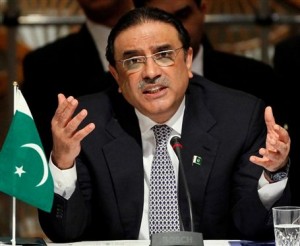
What comes to your mind with the mention of Asif Ali Zardari? “A cunning, vile, and corrupt man,” said my 19 year old cousin. This was a good summation of what the urban middle-class thinks of him. The more I hear people talking about him the more I am convinced of the power of propaganda. “Give the dog a bad name and hang him,” Zardai once said about himself. That is what is at work here.
Despite what has been said about him, Zardari did have a political background. His father Hakim Ali Zardari entered politics well before Partition and was a member of the Khaksaar Tehreek in 1931. He was first elected to the National Assembly in 1970s. All this talk of Zardari as a political orphan who hogged the Bhutto dynasty upon marriage with Benazir, is a non-starter. In Benazir’s husband, the Bhutto family wanted someone who would remain loyal to her. That is exactly what they got in him. For Zardari, family would always come first. This was the case at the time of Benazir’s death, when he kept the family together. Benazir would often tell close aides that despite his failings, Zardari always remained loyal to the family.
During the ’80s and ’90s Zardari moved from the Prime Minister’s house to prison and back to the Prime Minister house again. All in all, Zardari’s time in prison comes to a total of 11 years. It is ironical that if convicted, all of the cases he is implicated in have a combined sentence of only 10 years. This easily makes him the biggest political prisoner of the country. In 1999, he was almost tortured to death, with the government alleging that he attempted suicide by cutting off his tongue. He developed spondylitis because of rickety police van rides from Karachi to Lahore for court hearings. He could either sit on a wooden bench or stand straight. He started walking with a cane and had to undergo physiotherapy. It is well within imagination that during this time, Zardari could have brokered a deal with the establishment, broken with Benazir and went into exile. Instead, what happened was that Benazir was murdered and Zardari took over a country divided on ethnic lines, on the brink of an economic meltdown, with a full-fledged insurgency in Balochistan and an ever growing militant threat.
Today, the greatest criticism of the Zardari regime is its massive involvement in corruption. While it is impossible to defend the regime’s corruption and nothing can excuse it, one is forced to think that the whole idea of corruption is inverted in this country. The narrative of corruption has two problems. The first is its singular focus on elected politicians. One hears a lot about politicians being corrupt but almost nothing about the enormous amount of corporate corruption. Corporate corruption is the most heinous form of corruption today. However, in Pakistan it would seem that every corporation is working well within its boundaries and is completely cognisant of its responsibilities. A major part of this corruption is related to the Pakistani military which has the greatest economic stake in this country. Are all these military-run business giants working cleanly? Is the military’s $17 billion business empire clean? Is the acquisition of 12 million acres of public land by the military clean?
Although it is the Government’s responsibility to weed out this menace, it would be wishful thinking to demand that a weak civilian government stand up to an overpowering army. Nevertheless, it is the parliament, and not the judiciary, which probed corruption in National Logistic Cell (NLC), a military-run organization, and indicted two Lt. Generals and one Major General. The Supreme Court today is in essence the anti-corruption regime of this country however almost all of the cases it has taken up involve civilian politicians. It does not receive much attention that the judiciary’s own performance with regard to disposal of cases and prosecution of terrorists has been questionable.
The second problem with the corruption narrative is the middle class’ concept of corruption. For the urban middle class a non-corrupt state would mean a laissez fair system which would leave the rural population at the mercy of the corporates. The Pakistani term for such a system is ‘meritocracy’ or ‘technocracy’. This is also why the urban middle class, which dominates the media, bureaucracy and military, fails to understand why the same ‘corrupt’ politicians come back to power through elections. Rural voters vote for people who they think can best connect them to the ‘English speaking state’. They are concerned with immediate issues such as tube-wells, canal lining, roads, employment, sanitation, water. They live largely aloof from the issues that the mainstream media raises. This is also the reason why Jamshed Dasti was re-elected despite a fierce campaign against him by the middle class.
The middle class rhetoric against ‘corruption’ is not unique to Pakistan. In India, a similar movement led by Anna Hazare calls for passing a Lokpal (Ombudsman) Bill which would make elected representatives accountable to a committee of ‘good’, ‘clean’ but un-elected citizens. Unlike Pakistan, however, the Indian media has been very critical of this movement. It is also worth mentioning that corruption in Indian politics way surpasses the corruption here. To cite an example, just the 2G spectrum allocation scam cost the Indian exchequer $39 billion.
So while we castigate the current regime’s corruption, which we should, we should also be cognisant of the parallel narratives of corruption. In this country politicians have continually been booked for corruption while everyone else goes scot-free.
Finally, there have been substantially positive things that have been initiated by this regime but they need several articles to discuss. For now we can do with just noting them. The NFC award, the 18th and 19th Amendment, the Devolution plan, and the Benazir Income Support Program are all success stories to say the least. It is for the first time that we have a functioning Parliament (in which the opposition and government coexist), an independent and aggressive judiciary, and a free media, all at the same time in this country. All of these are institution-building measures which shall have a lasting impact on the country’s political dynamics.
(The writer works with a think tank in Islamabad. These are his personal views. His email is abdullah.muhammad.zaidi at gmail dot com.)
Subscribe to:
Posts (Atom)