Thursday, August 2, 2012


Lights out for ‘shining’ India

India power cut hits millions, among world's worst outages

Hundreds of millions of people across India were left without power on Tuesday in one of the world's worst blackouts, trapping miners, stranding train travellers and plunging hospitals into darkness when grids collapsed for the second time in two days.

Stretching from Assam, near China, to the Himalayas and the northwestern deserts of Rajasthan, the outage covered states where half of India's 1.2 billion people live and embarrassed the government, which has failed to build up enough power capacity to meet soaring demand.

The cuts in such a widespread area of the world's second most populous nation appeared to be one of the biggest in history, and hurt Indians' pride as the country seeks to emerge as a major force on the international stage.

"It's certainly shameful. Power is a very basic amenity and situations like these should not occur," said Unnayan Amitabh, 19, an intern with HSBC bank in New Delhi, before giving up on the underground train system and flagging down an auto-rickshaw to get home.

"They talk about big ticket reforms but can't get something as essential as power supply right."
Asia's third-largest economy suffers a peak-hour power deficit of about 10 percent, dragging on economic growth.

Between a quarter and 40 percent of Indians are not connected to the national grid.


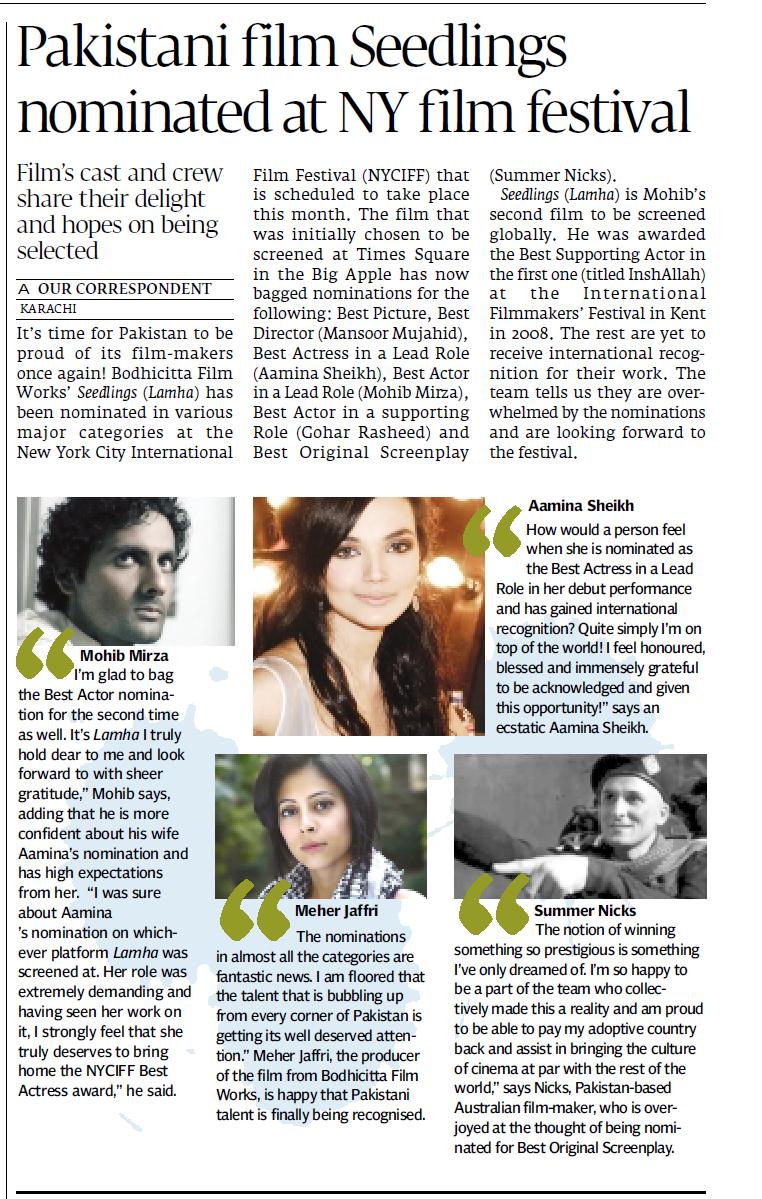
Pakistani film Seedlings nominated at NY film festival

It’s time for Pakistan to be proud of its film-makers once again! Bodhicitta Film Works’ Seedlings (Lamha) has been nominated in various major categories at the New York City International Film Festival (NYCIFF) that is scheduled to take place this month. The film that was initially chosen to be screened at Times Square in the Big Apple has now bagged nominations for the following: Best Picture, Best Director (Mansoor Mujahid), Best Actress in a Lead Role (Aamina Sheikh), Best Actor in a Lead Role (Mohib Mirza), Best Actor in a supporting Role (Gohar Rasheed) and Best Original Screenplay (Summer Nicks).
Seedlings (Lamha) is Mohib’s second film to be screened globally. He was awarded the Best Supporting Actor in the first one (titled InshAllah) at the International Filmmakers’ Festival in Kent in 2008. The rest are yet to receive international recognition for their work. The team tells us they are overwhelmed by the nominations and are looking forward to the festival.
Mohib Mirza
I’m glad to bag the Best Actor nomination for the second time as well. It’s Lamha I truly hold dear to me and look forward to with sheer gratitude,” Mohib says, adding that he is more confident about his wife Aamina’s nomination and has high expectations from her.  “I was sure about Aamina
’s nomination on whichever platform Lamha was screened at. Her role was extremely demanding and having seen her work on it, I strongly feel that she truly deserves to bring home the NYCIFF Best Actress award,” he said.
Aamina Sheikh
How would a person feel when she is nominated as the Best Actress in a Lead Role in her debut performance and has gained international recognition? Quite simply I’m on top of the world! I feel honoured, blessed and immensely grateful to be acknowledged and given this opportunity!” says an ecstatic Aamina Sheikh.
Meher Jaffri
The nominations in almost all the categories are fantastic news. I am floored that the talent that is bubbling up from every corner of Pakistan is getting its well deserved attention.” Meher Jaffri, the producer of the film from Bodhicitta Film Works, is happy that Pakistani talent is finally being recognised.
Summer Nicks
The notion of winning something so prestigious is something I’ve only dreamed of. I’m so happy to be a part of the team who collectively made this a reality and am proud to be able to pay my adoptive country back and assist in bringing the culture of cinema at par with the rest of the world,” says Nicks, Pakistan-based Australian film-maker, who is overjoyed at the thought of being nominated for Best Original Screenplay.

London Olympics Men’s Hockey: Pakistan’s way to victory

August 2, 2012
PHOTO: REUTERS

Pakistan has done it again! Defying the pundits, Pakistan defeated Argentina by two goals to none in their second pool match of the 2012 London Olympics Men’s Hockey competition. In a nail-biting match, both teams played fast attacking hockey and made frequent inroads into each other’s defences.
Pakistan drew first blood 30 minutes into the game, when defender Muhammad Imran scored from a direct penalty corner drag flick. The second goal also came off a penalty corner strike when captain Sohail Abbas’ powerful drag flick found the left post in the 44th minute of the second half. Though Pakistani forwards displayed occasional cohesion and short passes, overall they featured at an individual level, making fast runs whenever they could, finding spaces and attempting to pierce the Argentinian defence with individual stick work.
During the game, players playing forward missed quite a few scoring chances, and it was the penalty corner strikers who saved the day for Pakistan.
Whether this strategy of individual play by the Pakistani forward line will prove to be effective against the packed defence of stronger teams like Great Britain and Australia, is yet to be seen. Perhaps the need is for the team manager, Akhtar Rasool and coach Khawaja Junaid, to revise this trend and add mid field support to the forward line, so that attackers are not left to their own devices to penetrate the defence but move in trios adding more play and tactics to the game.
This game also highlighted a variation in Pakistan’s penalty corner routine with Muhammad Imran taking the first strike instead of Sohail Abbas.
Overall, the green shirts played well and were a treat to watch. It must be said that it is the Pakistani defenders to whom much of the credit goes for keeping the Argentinian attackers at bay and often saving the team in the last moments.
Full back, Muhammad Irfan, and half back, Rasheed Mahmood, proved to be a strong barricade for the Argentinian forward line. Goalkeeper Imran Shah was particularly in form under the bar, magnificently saving two of Argentina’s penalty corner strikes, and foiling numerous field goal attempts. However there were a few very serious fumbles by the defence line, to which stronger sides will not show any mercy.
With this win, Pakistan now have four points from two games and as Great Britain’s match against South Africa earlier in the day resulted in a draw, there is a glimmer of hope for Pakistan to make it to the semi final stages. But Great Britain who have home advantage and world champions Australia will prove to be strong adversaries. Moreover,  South Africa ─ though lowly rated in world rankings ─ should also not be taken lightly.
It is vital that our team management reviews videos of their opponents in the tournament and chalks out a workable game plan for these important encounters. More manpower is needed in the attack.

Team Pakistan sweeps debating competition in Mexico

The team beat South Korea in the finals. Two team members, Zainab Hameed and Azeem Liaquat, bagged the first and second position respectively as the best speakers at the competition while the third member, Ahmed Shujaan, scored the fifth position. PHOTO COURTESY IDEA
KARACHI: For the three 15-year-old students selected to represent Pakistan in one of the largest high school tournaments in the world, The Karl Popper Debating Championship (KPDC), the first-time visit to Mexico became their time to shine.
Not only did the Pakistani team win the final against the team from South Korea, but all three participants were listed in the top 10 speakers of tournament. The titled was achieved after winning through 6 preliminary rounds, 3 elimination rounds and the grand final.
Karachi Grammar School student Zainab Hameed was named the top speaker of the competition while Azeem Liaquat, student of the Salamat International Campus for Advanced Studies in Lahore, came second. Their compatriot, Ahmed Shujaan from the Aitchison College, was not far behind either and bagged the fifth position among more than 200 participants.
Teams from 45 countries came together to debate on a mix of prepared and impromptu motions. The event was a part of the 18th edition of the International Debate Education Association (IDEA) Youth Forum held in Mexico from July 2 to 15.
This topic for the KPDC finals was “Guantanamo Bay prison should be closed down immediately”. Team Pakistan was defending the motion while team Korea had the burden to prove that the motion should not be adopted.
The teams participated in two competitions –the KPDC and the mixed team track. In the former, they represented Pakistan as a team while in the former, they were split up and paired with debaters from other countries.
First time for everything
“It was the first time that Pakistan participated but it was also the first time that any team won with all nine votes of the judges in its favour,” said team Pakistan’s coach, Daniyal Asad, also the general secretary of the Debating Society of Pakistan. Asad also won the best coach cum adjudicator award.
A two-day selection camp, comprising the top 20 speakers at the “Under-17 Pakistan National Debating Championship”, was arranged by the Debating Society of Pakistan in Lahore. The participants were primarily the O’ level or matriculation students out of which Zainab, Ahmed and Azeem were selected.
Asad told The Express Tribune that the society has been running the debating circuit across the country successfully for the past 20 years without help from the government. “Some form of patronage from the government would have helped in grooming the talent.” The expenses of trip were paid by the US-based Open Society Foundations.
Team effort
After being selected for the competition, a five-day training camp was organised by the debating society in Lahore, following which they continued to research and collaborate for about two weeks through online mediums because Zainab was in Karachi while the other two participants were based in Lahore.  “We had a lot of team chemistry right off the bat and that was probably the main reason that we were successful,” said Zainab. She gave credit to the coach and other trainers for strenuously helping them all the way through.
“We didn’t actually have a lot of knowledge about topics like civil liberties and terrorism,” said Zainab while talking about the competition’s theme. “We didn’t even know that the Guantanamo Bay is actually a legal black hole but we had to defend the motion in the finals.” Zainab recaps that the moment their victory was announced, everybody except for the three stunned team members were cheering them on while chanting “Pakistan… Pakistan”.
“It was not only a competition but also a great learning experience during which we got to prove our talent,” said Ahmed.
He recalled one of the most memorable moments for the team when the three performed “bhangra” in traditional Pakistani outfits at the talent night.
Maya Khan and the barbaric arrogance of fundamentalism

Sunil converting to Islam was perfectly legal, but what if a born Muslim wants to convert to another faith? Why is that illegal under Pakistani law?
It is apparently not enough anymore to discriminate against religious minorities in our laws or to attack their houses of worship or places of residence in random, unprovoked acts of violence. People like Maya Khan now want to use the few remaining religious minorities in the country for entertainment too.
Many publications have rightly pointed out that the televised conversion of a Hindu man named Sunil to Islam was an act that was incredibly insensitive to religious minorities in a country where forced conversions and abductions are far too common. But I have a far deeper problem with just the act of televising it. My problem is with the social attitudes among the majority of Pakistani Muslims that make televising such vile programmes profitable.
Let us start with the people who were part of the studio audience. Most of these are part of the urban middle class of this country and likely have a better education than the average Pakistani. They seemed rather delighted at what they were witnessing and eagerly suggested “Muslim” names for the young man. I have two major problems with this.
The first is this: being happy about somebody converting to Islam means that you fundamentally believe that the person’s previous religion is inferior to Islam. Here is my question to all those Muslims who get excited about religious conversions: how much do you know about other religions of the world? How much do you know about your own religion? Do you even know why you are Muslim?
The answers “because I was born one” or “because it is the right religion” were the same ones that the pagan Arabs gave to the Prophet Muhammad (PBUH) when they tried to justify why they rejected Islam and continued with their old faith.
Incidentally, most people are probably unaware of where the tradition of changing names comes from. Most people who converted to Islam during the Prophet’s time were not asked to change their names, only those whose names were explicitly linked to other gods. It started when a man named Abdul Uzzah al-Juhani converted to Islam and the Prophet asked him to change his name to Abdullah, since Uzzah was the name of a pagan Arab god.
“Sunil” means “dark blue colour”. Going by Prophetic tradition, there was no need to change the man’s name. But of course, most of the audience did not know that because they do not know why they are Muslim, just that they are and somehow that is a good thing.
It is funny how some misguided Muslims malign pagan cultures, but fail to remember that making a spectacle of denigrating other religions is something that we get from the most famous of all pagan cultures: Rome, which made a habit of feeding Christians to animals for the entertainment of the crowd at the Coliseum.
This brings me to my second problem: how a lot of fundamentalist Muslims are utterly convinced of the superiority of Islam – and seek legal codification of that superiority in Pakistan – while demanding equal treatment in other countries. Sunil converting to Islam was perfectly legal, but what if a born Muslim wants to convert to another faith? Why is that illegal under Pakistani law?
Religion, at the end of the day, is not your identity. It is a set of ideas about morality that you hold. Like any other set of ideas, it is just an opinion and deserves no special treatment compared to any of your other opinions. It should be protected under freedom of expression, but not much else. And like any opinion, people should be free to change it as they please, no matter what religion they were born into.


In a telephonic interview with Agha Waqar Ahmed on July 29, 2012, for Sindh Express, most of my questions to him were about the physics, thermodynamics and chemistry behind his water kit. However, some questions regarding thermodynamics were not addressed as they should have been and I felt as though Waqar knew more about the ‘engineering’ behind his kit but not the ‘physics’ that went into it. Though it is not mandatory for an inventor to be a PhD, this age of fraudulent and quack inventions calls for every aspect of an invention to be examined thoroughly. Allow me to refresh ...

A car that runs on water?

Published: August 2, 2012
Japan had already invented water generators in 2008 and we're claiming to have invented them in 2012. PHOTO: REUTERS
In recent days, talk show hosts who really should know better have been touting a peculiar invention known as the water kit. An engineer has claimed to have found a way to use water as a fuel that can run cars. He claims to have done this by splitting the oxygen and hydrogen molecules in water, a feat which, if real, would represent one of the greatest breakthroughs in the history of science. However, we must not forget that water is not a fuel and the fact that the matter is being debated and hyped up without proper scientific investigation, displays our profound scientific illiteracy and the media’s irresponsible response to this claim.
Belief in the ability to run vehicles on water seems to now have become a matter of national pride. Nuclear scientist Dr Abdul Qadeer Khan, whose hyper patriotism seems to have swallowed the scientific nous he possesses, has treated the ‘discovery’ as if it was real without examining it scientifically. The cabinet, perhaps, in a burst of excitement at the prospect of our energy woes being solved, wants a demonstration of the water kit. A lone scientist or two have been trying to inject sanity into the debate but have been shouted down by others who see a genuine scientific breakthrough where none may exist. We have often been accused by our detractors as a people ruled by emotion rather than reason. By being gullible enough to believe that we can use water as a fuel, we are doing our best to live up to the caricature.
The problem here is that we are so insecure about our achievements on the world stage that when one of our own claims to have done something incredible, our first instinct is to believe him, defend him against all criticism and see the person as improving the image of the country. Naysayers are instantly denounced as self-loathing individuals. Meanwhile, those who have genuinely advanced scientific knowledge in their fields, like Dr Abdus Salam, are forgotten simply because of their religious beliefs. It is sad that when the Higgs boson particle was recently discovered, none of our media pundits conducted the kind of extensive talk shows on Dr Salam’s contribution to this great discovery, like the ones they have devoted to the ‘invention’ of the water kit.

The truth about Agha Waqar’s water car kit

 August 1, 2012

Japan had already invented water generators in 2008 and we're claiming to have invented them in 2012. PHOTO: REUTERS

Our social media and our mainstream media are known for publishing news irresponsibly and without verification. I was compelled to write this blog which is aimed at highlighting another instance of unverified reporting by the media.

Some days ago, my friends told me about a certain episode of Hamid Mir’s programme “Capital Talk” on Geo TV. This episode was about a man called Agha Waqar – a proud Pakistani who claimed to have invented something called a ‘water car kit’.
Obviously, the first thing that I said upon seeing this was “Bravo!”, as I personally have an interest in alternative energy systems and efficient energy. I was swiftly becoming a fan of Waqar, the inventor of this incredible device. However, soon I recalled that a few years ago I had watched a video about something similar; a video about Japan having successfully tested a car that runs on water. This was back in 2008. While it is true that in early 2009, Genepax announced they were closing their website, citing large development costs, the fact remains that Hamid Mir stated their venture as “na kaam”. This is not true as the Japanese did successfully invent a car that ran on water. Why Genepax closed down is a different story altogether which should have been looked in to by the media.


I thought there might be some difference between the device Waqar had invented because our media had been publicising it as if it were a miracle, and so I started searching the internet for car kits that run on water. It didn’t take me very long to find a similar device selling for $80 on online shopping sites, eBay and Ali Baba.
The Japanese have invented mini generators for generating electricity through water in homes to operate small electrical appliances like laptops, small chargers, videogame consoles and so on. They claim that these generators can produce electricity by making use of any kind of water. It doesn’t have to be distilled, even tap water or tea can be used for this!
I wondered if generating electricity at home was really that easy because if it were, the media would not be praising someone who claims to have introduced an obsolete notion. It was then that I found many DIY videos and tutorials on YouTube about conveniently building hydrogen water generators at home. In fact, I even came across articles that showed a step-by-step procedure for building this generator.
Although I have great respect for Agha Waqar for at least taking initiatives for introducing this technology in Pakistan, it saddens me that our media is claiming that something the world already saw decades ago has been invented by us in 2012. Yes, the previous ventures might have failed, but how can we state with certainty that this one will work or is any different? For all we know, this venture might bear stark similarities with the ones previously invented or might even be an exact replica, and all I am saying is that people should not be mislead to believe something that may not be true.
Only time will tell whether Agha Waqar’s water-kit is a feasible idea.
However, on a more positive note, I hope that we can make some improvements in this technology and introduce it to the public for commercial use.


The water car fraud

Published: August 2, 2012
The writer received his bachelor degrees in electrical engineering and mathematics, as well as masters and Ph.D degrees, from MIT
Agha Waqar Ahmad deserves a medal from the people of Pakistan for his great service to the nation. In a few short days, he has exposed just how far Pakistan has fallen into the pit of ignorance and self-delusion. No practical joker could have demonstrated more dramatically the true nature of our country’s political leaders, popular TV anchors and famed scientists.
At first, it sounded like a joke: a self-styled engineer, trained in Khairpur’s polytechnic institute, claims to have invented a ‘water kit’ enabling any car to run on water alone. It didn’t matter that the rest of world couldn’t extract energy from water; he had done it. He promised a new Pakistan with limitless energy, no need for petrol or gas, and no more loadshedding. For an energy starved nation, it is a vision of paradise.
Agha Waqar Ahmad is now a national celebrity thanks to Religious Affairs Minister Khursheed Shah. Federal ministers Mir Hazar Khan Bijarani and Qamar Zaman Kaira have added their commendations. President Asif Ali Zardari has expressed his delight. The cabinet has met three times to discuss the water vehicle, and a fourth meeting is scheduled. Reports suggest millions may be spent on the ‘water fuel kit project’.
The media has rushed in to celebrate the new national hero. For TV anchor Talat Husain, thanks to Agha Waqar Ahmad’s invention, Pakistan’s image can go from a country ravaged by terrorism to one of boundless possibilities. Anchor Hamid Mir and Senator Parvaiz Rasheed drove around Islamabad sitting next to the inventor, wondering how to protect the man’s life from Western oil companies. Anchor Arshad Sharif was euphoric about the $14 billion Pakistan would save on oil imports.
Pakistan’s most celebrated scientists were not far behind. Asked by Anchor Sharif whether a car could run only on water, nuclear hero Dr Samar Mubarakmand replied without hesitation: “jee haanbilkul ho sakta hai” (yes, absolutely possible). For his part, Hamid Mir asked Dr AQ Khan if there was any chance of this being a fraud. The response was clear: “Main nay apnay level per investigate kiya hai aur koi fraud waraud nahi kiya hai” (I have investigated the matter and there is no fraud involved). The head of the Pakistan Council of Scientific and Industrial Research, Dr Shaukat Parvaiz, went further: “hum nay bhi iss pay kam karaya tha” (we had some work done on this too).
So, what is the problem? It’s that the laws of physics, in particular a fundamental scientific principle known as the Second Law of Thermodynamics, impose inviolable constraints. Every machine constructed anywhere uses the Second Law. This is something that I learned in my first year as a student at MIT and have taught for 40 years. No serious scientist would dream of challenging the Second Law. Agha Waqar Ahmad’s ‘water kit’, if one believes science to be right, simply cannot work. What the inventor, the ministers, the anchors and scientists claim on TV is wrong.
To his credit, the only person on TV that seemed to know this elementary principle was Dr Attaur Rahman, a chemist and a former HEC chairman. I have not agreed with all his actions and views in the past, but he alone rejected the claims about the new machine. Sadly, he was not able to hold back the tide of a nation desperate for any answer to its energy woes.
The water fraud will be exposed soon enough and, like a bad posterior smell, will go away. A simple experiment will make this happen faster. Here’s how: take an emergency electricity generator, of which there are thousands in Islamabad. Its engine is similar to that in a car. Remove the fuel tank and make sure the ‘water kit’ contains only water. Then ask the inventor to connect it up and run the generator. Let there be enough sharp-eyed witnesses of intelligence and integrity.
But this episode raises bigger questions. Scientific frauds exist in other countries, but what explains their spectacular success in Pakistan? Answer: our leaders are lost in the dark, fumbling desperately for a miracle; our media is chasing spectacle, not truth; and our great scientists care more about being important than about evidence. It is easy for them all to get away with this. As a nation, we have proven unwilling to do the hard work needed to learn to reason, to be sceptical, to demand proof, to understand even basic science. It is easier to believe the world is run by magic and conspiracies, to wish and wait for Aladin’s magic lamp. We live in the age of jahilliya.

Aamir Liaquat: The second coming

July 6, 2012
Flashy, flamboyant and witty in his televangelism, Aamir Liaquat is a burning bright spot in an otherwise drab landscape of mirthless religious pundits.

Remember when Superman lost his life in a war against the seemingly unstoppable alien, Doomsday, in order to defend Metropolis?

Except it turned out that he hadn’t really died and instead was actually just recharging in a Kryptonian regeneration mix for a few months so that he could return – fully alive and functional (notwithstanding that terribly embarrassing mullet).

Now, Pakistan’s Ramadan hero, Dr Aamir Liaquat, will be joining the ranks of famed second comebacks so favored by comic books and holy scriptures.
Yes, the rumor mill got it right this time around. Liaquat, who has often fallen from grace in the eyes of many Pakistanis - mostly due to his systemic discrimination against religious minorities and a leaked video of the nation’s favourite commerical Mullah launching expletives and giggling at rape - will be returning to his original stomping grounds, Geo TV.
Since mid-June Pakistani Twitterai was abuzz with the Aalim’s possible comeback.
Equally abuzz was Geo which was busy shamelessly promoting the fact that ‘Someone is Coming’ by way of teasers, quarter-page advertisements, and this.
Undoubtedly, Geo’s apology and the reinstating of the Aalim, with much pomp and circumstance, is a score composed solely of dollar signs. Just the way you have to put forth the chocolate to have kids eat their vegetables, Geo knows it needs to put forth a tried, trusted and true honey trap which will guarantee that your Ramadan of samosas, lassi, and the Qasida Burda is complete. Geo’s Ramadan is mega-lucrative after all.
Cue Aamir Liaquat.
Like a UN Goodwill Ambassador helping spur Geo’s economy, he has returned to the very network he once alleged was responsible for leaking the much contested, expose-all video. Also, the same network from which he was let go following a broadcast in which he urged fundamentalist Muslims to kill members of Pakistan’s minority Ahmaddiya population.
Flashy, flamboyant and witty in his televangelism, Aamir Liaquat is a burning bright spot in an otherwise drab landscape of mirthless religious pundits. As our source flatly puts it:
Last year he did very well at ARY; and viewers thrive on emotion- he knows how to cater to that and he knows ke TV business ko kaisey chilana hai (how to run the TV business)”.
In an era of meticulously managed and manicured celebrity personas, Liaquat is a salacious mix of both.
First, he reels you in. Your eyes are drawn into whichever gaudy sherwani he’s decided to don that day. Then, the rest of you is sucked in too, as he begins, with bullet point precision, to lay down the (Islamic) law.
So what if his questionable off-screen persona  probably wouldn’t stand up under Sharia cross-examination?
He’s got the nation hooked on his dosage of flashy religion. Whichever TV network is featuring him doesn’t even have to do much to sell him to us viewers. Just like the three most comforting words,  ‘By Steven Spielberg’ on a blockbuster movie trailer, Dr Aamir Liaqaut with that 50′s coif and slim-cut, bejewelled sherwani is the most comforting image alongside your packaged Medina ke khajoors this Ramadan.
Geo knows this. So, naturally they are going to milk this cash cow dry. Cha-ching, jackpot.
However, forgetting Aamir Liaquat’s prior transgressions (fake degrees, profanity, racist bigotry) would be like forgetting what Ahab was trying to kill in Moby Dick
Now to be fair, who knows what amount of authority he’ll be able to throw around as one of the  head honchos of Geo. Our source is equally unsure of the exact degree of authority but is of the opinion that there will be little impact on Geo News and more so on Geo Entertainment.
Regardless, all this has been enough to elicit a collective ‘Hawww’ from the majority of us confused bystanders who haven’t felt this flabbergasted in quite some time (which on a Pakistani timeline is, unfortunately, 10 days).
And it has been enough to warrant some drastic action on the part of some very unhappy people within the Geo network.
On July 1 the good folks at Cafe Pyala reported that:
“…A full blown revolt has now erupted within Geo’s editorial management…among the people said to be extremely unhappy, are Managing Director Geo News Azhar Abbas, Director Content Development Muaaz Ghamdi and star anchors like Sana Bucha (Lekin), Najam Sethi (Aapas Ki Baat) and Ifthikhar Ahmed (Jawaabdeyh)”.
There were also reports of an internal petition being circulated against Mr Jeem’s reappointment.
Today our source confirmed that Sana Bucha may possibly be leaving Geo. But as of this morning it was not yet confirmed whether Sana Bucha had tendered her official resignation – all that had been confirmed was that Maria Memon would once again be stepping in to host Sana Bucha’s Lekin this week.
“In Pakistani media, log kum hotay hain (there are very few peopleand if someone is doing a good job usko (dusra network) utha leyta hai ( the other networks hire them). So this is not only about Aamir Liaquat. It’s about (Sana Bucha) getting a better deal and knowing she can while she’s at the top of her game,” said the source.
“One thing is for sure – the issue with Aamir Liaquat and her could be resolved,” the source added.
That folks, is only just one screw of a very large and dizzying merry-go-round that is Pakistani media.
What with the return of Aamir Liaquat, Dunya TV’s sacking of Mubasher Lucman, Sana Bucha’s alleged resignation, and Meher Bokhari erring on the wrong side of professional ethics, perhaps the only real way Pakistani media can entertain us any further is by way of a mass collaboration featuring all its past fallen heroes and heroines.

Wednesday, August 1, 2012

Trade diplomacy: Why this should matter to Pakistan

Published: August 2, 2012
Trade with India was nearly 60% of Pakistan’s total at independence. That figure has dropped to 2.7% in 2011, a level most economists consider unnaturally low. ILLUSTRATION: JAMAL KHURSHID.

KARACHI:  Make no mistake: New Delhi’s decision to allow Pakistani individuals and firms to invest in India is far more than just a political gesture. It is a move that has the potential to drastically reshape the Pakistani economy, and mostly for the better.
One might be forgiven for thinking that the move is largely symbolic. After all, Pakistan is not exactly known as a major source of foreign direct investment in any part of the world. Indeed, we are a net recipient country and grateful for every dollar that comes our way. But the move by India nonetheless has important consequences and needs to be understood in its full context.
Put simply, before this law was changed, no Pakistani firm could set up a registered company in India. This may not seem like much, but consider the following example. That Pakistani lawn garments are highly popular in India is by now a well-documented fact. Many commentators have gone on to ask why Pakistani lawn designers and manufacturers do not actively market to Indian consumers. Why, for instance, does Gul Ahmed or Al-Karam or Sana Safinaz not set up retail outlets in Mumbai or Delhi?
The reason they do not is that, in order to have any presence in India, they would first need to register a subsidiary company. However, registering a company requires putting up capital, even if it is for small amounts and does little more than setting up an office or a few shops. In any country other than one’s home country, such an act would technically be classified as “foreign direct investment”, which until now has been illegal for Pakistani firms.
Now that India has legalised foreign direct investment from Pakistan, Gul Ahmed or any other Pakistani company can set up Indian subsidiaries to begin marketing their products to consumers on the other side of the Wagah. Indian companies should really not fear this: Pakistani firms will still likely seek partnerships with their Indian counterparts and create opportunities for commercial collaboration that benefits both sides.
The amounts of capital moving from Pakistan to India will probably not be very big, at least not in the initial decade. But being able to “invest” in India is really a licence to freely to do business in India, or at least as freely as any other foreign investor.
The Indian government, in its announcement, has said that Pakistani companies and individuals will be able to invest in all sectors except “defence, space and atomic energy”. This, however, is likely a slightly misleading statement since the Indian government has all sorts of restrictions on foreign investment in various sectors and it is unlikely that Pakistani companies will be given more favourable treatment in India than, for example, American ones.
The most famous example of this is the retail sector, where foreign companies are still not allowed to sell more than one brand in their retail outlets. This restriction will not matter to Pakistani textile companies seeking to market lawn in branded shops, but those multi-brand clothing outlets now booming across the country will likely not be able to cross the border.
Nonetheless, once Pakistani companies begin selling more to Indian consumers, the direction of Pakistan’s trade is likely to transform. Remember that trade with India was nearly 60% of Pakistan’s total at independence. That figure has dropped to 2.7% in 2011, a level most economists consider unnaturally low. It needs to rise, and Pakistani firms being able to operate normally in India will tremendously boost that phenomenon.
For those of you who are curious as to whether or not Indians are allowed to invest in Pakistan, they have been allowed to invest in Pakistan – with the ability to repatriate 100% of their capital – for about two decades now, when Pakistan first adopted the principal of not discriminating between foreign firms and local ones (with very few exceptions).
Until now, hardly any have taken it up, but once they see Pakistani firms coming into their own backyards, some might consider jumping the border. And once they discover the relative ease of doing business in this country, they may well come to like it.

Islamophobia and Huma Abedin

Hillary Clinton aide Huma Abedin, left, Representative Michele Bachmann, centre, and Senator John McCain, right. PHOTO: REUTERS

Islamophobia is mounting in the developed world, with a big contributing factor being ignorance. Without understanding the true religion, the West has wrongly formed an ignorant opinion of Islam, associated with terrorists who have no right to be called Muslims.

Recently, Huma Abedin, a Muslim woman, who is deputy chief of staff to Hilary Clinton was accused of having ties with radical Islam. Five prominent members of the Republican Party and congress sent a letter to the Deputy Inspector General of the State Department, accusing Hilary Clinton’s aide Huma Abedin of ties with the Muslim Brotherhood.
From the members of the Republican Party who signed this letter, the most prominent is Michele Bachmann, who was being considered by the Republicans as a presidential candidate. The Muslim Brotherhood is a political Islamic organisation which was founded in 1928, particularly very active in the Arab world and has been accused of an ‘international plot to overthrow governments of Arab countries’ by many, including the Dubai police.
According to the letter sent, Abedin’s three family members specifically her late father, mother and brother were directly connected to the Muslim Brotherhood in Egypt. The inclination given is that Abedin has influenced the softening of policy in the White House towards the Muslim Brotherhood which can produce hazardous results for the US since the Muslim Brotherhood intends to destroy western civilisation from within.
However, the US government states that it does not view the Muslim Brotherhood as a terrorist organisation, given that it had not carried out a violent activity for the past fifty years. That said, the US government is very thorough when conducting research on potential employees of the White House, so obviously Abedin was not viewed as a threat. In fact, on being asked about Huma Abedin, the Muslim Brotherhood responded with a confused ‘Who?’
Not all Republicans have attacked Abedin’s reputation, with Senator John McCain amongst others rising to her defence.
“These attacks on Huma have no logic, no basis and no merit. And they need to stop now,” McCain had said.
http://www.youtube.com/watch?v=ao8wIq2HMAg
I have new-found respect for Senator McCain and what Hilary Clinton stated really hit home for me:
“Leadership is incredibly important. Leaders have to be active in stepping in and sending messages about protecting the diversity within their countries. And frankly, I don’t see enough of that, and I want to see more of it. I want to see more of it, and we did see some of that in our own country. We saw Republicans stepping up and standing up against the kind of assaults that really have no place in our politics,” Clinton said.
Killing of innocents by so-called Muslims does not reflect what Islam teaches. Although jihad is a part of Islam, it has nothing to do with killing innocent people. Besides, what about the good that we’ve done? Why must the true spirit of Islam be overshadowed by those killers, terrorists and intolerant fanatics who have no right to be called Muslims?
It does seem a bit preposterous that Abedin would be connected to the Muslim Brotherhood, or have an extremist Islamic agenda. The woman’s dress sense, to begin with, isn’t very modest according to Islamic standards as seen by her photo shoot in Vogue Magazine in 2007, where she wore a daring low cut red dress. She is also married to a Jewish man and has a baby with him!
That said, the issue is deeper than just one person. The letter actually accused quite a few people indirectly, and the reason why Abedin was brought to the limelight is that her name was specifically mentioned.
There is an underlying fear that Islam poses a threat to the western style of life – a fear which refuses to rationalise the fact that Muslims have been living peacefully in the west for hundreds of years. This is due to ignorance and it is this ignorance about the true meaning of Islam which is in dire need of being addressed in order to avoid such fear and misunderstandings in the future.

August 1, 2012