Wednesday, February 13, 2013

Sindh will be a much better place than Sind!

The Taliban will teach dramatics at NAPA and the Lyari gangsters will prepare a team of soccer players for the next EPL.

It was a very proud moment for the Sind(h) assembly when the members “unanimously” agreed that an amendment bill be passed officially correcting the spelling of the province of ‘Sindh’ which was incorrectly reported by Radio Pakistan earlier to have been changed to “Sind”.
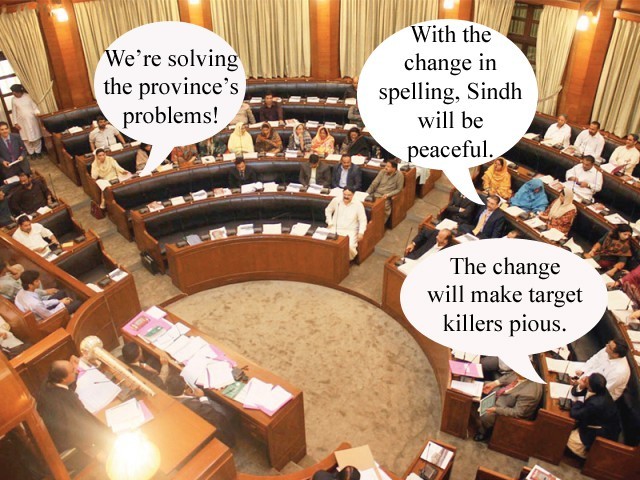


The people of the province eagerly awaited the verdict for this diabolical, life-threatening issue. Now that it has been resolved and clarity has been brought forth, this step will certainly bring prosperity, rule of law, health care and education to the Sind(h)is of Sind(h).
Having named everything possible after Benazir Bhutto, the highly competent members of the Sind(h) assembly achieved what no other government could. This time-consuming correction will bring the province of Sind(h) at par with thriving economies like South Korea, China or maybe even Japan!
Cornel, Harvard and MIT might consider opening their campuses in Sind(h) and foreign investments will come pouring in. Foreigners will be frequenting their visits to discover the great potential Sind(h) has and people will leave their front doors open whence leaving for work due to the excellent security throughout the province. The change in spelling will also take Karachi stock market to a record high and probably will get the title of ‘fastest growing stock market’ in no time.
Unemployment will be replaced by mass job placements and foreign graduates will prefer coming down to Sind(h) to work, rather than Dubai, Malaysia or Singapore.
Extortionists will become entrepreneurs and kidnappers will become pious.
Cell-phone snatchers will open up their own mobile phone franchises while target killers will teach combat training at the primary school level. Shia Sunni communities will embrace each other and prefer offering namaz in each other’s mosques while the poor rural farmer will have plenty of land in his name to fulfill all his needs.
The Taliban will teach dramatics at NAPA and the Lyari gangsters will prepare a team of soccer players for the next English Premier League.
The change in the way we now spell Sind(h) will also bring rapid bus transit and circular railway projects to Karachi, Hyderabad, Nawabshah, Dadu, Sukkur and the rural-urban divide will get narrower and thinner.
The honourable Sind(h) assembly members have truly proven themselves as sons of the soil by addressing such a crucial issue and within no time had it passed through the Houses of Parliament to make sure no error like this diabolical one could ever be repeated.
Their level of intellect deserves appreciation, afterall, their will to resolve ‘core’ issues being faced by the province is exemplary, no doubt.
Sind(h) will soon be seeing a rejuvenated populace making its mark in the world and bringing laurels for the province. Government officers will be working day and night diligently and with all honesty and dedication just because now they are Sindhis and not Sindis.
God save Pakistan and its Sind(h)is.
 

Aangan Terrha: Lessons, nostalgia for the young and old

Published: February 12, 2013
Young actors bring back memorable performances to enthrall the audience. PHOTO:

KARACHI: 
Anyone would think twice before daring to replicate the unbeatable performances in ‘80s satirical-comedy drama Aangan Terrha. The brilliance in dialogues both written and delivered is still treasured by those who have watched it. Touching a script like that, especially for a stage performance, is a daunting task which could have resulted in a disappointment of gargantuan proportions. But director Dawar Mehmood and his team took up the challenge and succeeded.
Under the auspices of the legendary writer Anwar Maqsood, who is also the playwright for the original drama, young and passionate actors brought new life to the characters of a drama that is a part of our national archive. Yasir Hussain as Akbar, Hareem Farooq as Jehan Ara, Khalifa Sajeeruddin as Chaudhary Sahab, Nurjis Jafri as Hamsheera/Sultana and Talal Jilani as Mehboob Ahmed in the main roles left no stone unturned in giving us fresh rendition of Aangan Terrha.
Late Salim Nasir’s unforgettable role of a servant and former classical dancer in the drama is played by Hussain, who feels the role was a part of him. After witnessing his performance, veteran actor Bushra Ansari, who was a part of the original cast, gave him her blessings by saying: “Tum to Akbar ko ghol kay pee gaye, bohat achay”. While Farooq played Jehan Ara Begum, who appeared a lot like a younger version of Ansari, Sajeeruddin played the energetic Chaudhary Sahab.
The play Aangan Terrha is a pleasant break from the thumkas and item numbers that have infested Karachi theatre, and incredible one-liners by the master of satire himself are worth the watch.

While the class and charisma of the original drama has been retained, a bit of reinvention was expected and also needed for stage which unfortunately was not seen. Perhaps the only flaw was the lack of a theatrical feel, since the director has chosen to replicate on stage exactly what was on TV. Similar to the transitions in a TV play, the lights and music faded in and out as a changeover of wardrobe and props were needed, which was uninteresting for the audience.
A few issues in the venue gave way to some murmurs within the crowd. The number of people invited on media night exceeded the available seats at the Arts Council. This resulted in organisers requesting some children to vacate their seats for adults. Despite the fact that children under 12 were not allowed, a few crying babies were admitted into the auditorium, which became a source of disturbance during the performance. It would have been better if the audience had followed the rules, or the organisers had stuck to theirs.
A ticket worth Rs1,500 is certainly steep for Aangan Terrha, which is a play that people from all income groups would like to watch. This also casts a shadow of doubt on whether or not Aangan Terrha will complete a running of a 100 shows. Theatre is an industry that needs money, but it’s unreasonable to expect all income groups to pay such a price. The organisers would have had more ‘house full’ nights had it been a Rs500 ticket.
Verdict: Do watch Aangan Terrha for Anwar Maqsood’s hilarious one-liners, the incredible resurrection of Salim Nasir’s character Akbar and a nugget of how Urdu was once written and spoken. For the oldies, the play will bring back fond memories; for young members of the audience, it is a valuable lesson in culture and literature.
Published in The Express Tribune, February 13th, 2013.      

Gulzar goes back to India

Published: February 13, 2013
Indian poet Gulzar. PHOTO: AFP/ FILE

KARACHI: Oxford University Press (OUP) confirmed that Indian poet Gulzar, along with director Vishal Bhardwaj, has gone back to India soon after reaching Pakistan through the Wagah border.
“Regretfully, Gulzar returned to India via Wagah border today. It is a great loss for his readers and admirers in Pakistan,” Managing Director of OUP Ameena Saiyid told The Express Tribune via email.
Saiyid added that she did not have any direct information about a security threat. “I was taken by surprise by his sudden unplanned departure. I was getting ready to receive him at the Karachi airport tomorrow when I heard that he has returned to India.”
Another OUP official also confirmed that Gulzar and Bhardwaj have returned to India.
The Indian High Commission, when contacted by The Express Tribune, however denied involvement in sending Gulzar back.
First Secretary Press and Information of Indian High Commission Janardan Singh said that Gulzar’s visit was private and they were not aware of his itinerary. He refuted media reports which suggested that Gulzar was sent back to India by the high commission.
Bhardwaj told NDTV that their return from Pakistan was not due to political reasons.
He said that Gulzar was emotionally overwhelmed after visiting his birthplace in Dina after 70 years, and had to be escorted back to India immediately. The trip was made to record a song for his new film ‘Dedh Ishqia’ but the recording was cancelled as well, he added.
“There is nothing political about it. We plan to visit Pakistan again for recording as soon as Gulzar Saab feels better,” Bhardwaj was further quoted as saying.
Earlier during the day, media reports suggested that Gulzar was sent back to India from Wagah border due to certain “security concerns”.
Gulzar and Bhardwaj were due to participate in the fourth Karachi Literature Festival.
The festival will be attended by more than 200 literary luminaries from Pakistan and overseas. The event is free-of-charge and will run all day long from 10am to 7pm over a three-day period from February 15 to February 17.
British-Pakistani novelist Nadeem Aslam will be the keynote speaker at the inaugural session of the festival.

Defending drones

Published: February 13, 2013
The memo itself basically states the obvious: if you’re an al Qaeda member plotting to attack the United States or its citizens, and if arresting you is impossible, then you may be legally targeted.
Ultimately, the most serious challenges to US drone policy will not come from the protests of international human rights organisations or public denunciations by the governments in whose territories these strikes are carried out. The US has always been resistant to outside criticism of its policies, and such criticism has never, in the past, forced a policy rethink. Anti-drone voices also fall short when it comes to suggesting an alternative to drone strikes, expect perhaps by arguing that conflict itself should be avoided, which is an unrealistic view at best and utopian at worst. Moreover, the countries in which drone strikes are carried out, like Pakistan, protest only for domestic public consumption while privately encouraging the strikes and even allowing the use of their territories for bases from which the drone strikes are carried out.

If any checks will thus be imposed on the use of drones by the United States, it will most likely be as a result of domestic pressure exerted upon the state through the US judicial system. This is the context in which the justice department’s leaked 16-page document providing a legal justification for strikes on American citizens must be viewed. This document is a shorter, declassified version of a 2010 Justice department memo drafted to justify the killing of Anwar Awlaki, a US citizen and alleged al Qaeda member, in a 2011 drone strike. The Justice department document was likely drafted in response to, or in anticipation of, a suit filed by Awlaki’s father against his son’s inclusion in the CIA’s ‘kill list’. While conducting drone strikes on foreign citizens in foreign countries is apparently not an issue, it seems the US government is cognisant of the potential can of worms it opens when targeting US citizens who have been deemed “imminent threats”. The memo itself basically states the obvious: if you’re an al Qaeda member plotting to attack the United States or its citizens, and if arresting you is impossible, then you may be legally targeted.
Beyond its legal implications for the United States, this document also unwittingly provides a rationale for other states to use similar legal justifications for targeting their own citizens in foreign territories — something that may return to haunt the US in years to come.
Published in The Express Tribune, February 13th, 2013.
The rupee ended weaker at 98.06/98.11 against the dollar, compared to Monday’s close of 97.96/98.01. The rupee has come under pressure after Pakistan made a $145 million payment to the International Monetary Fund (IMF), dealers said. Heavy debt repayments to the IMF have been putting a dent in the central bank’s reserves, which have declined by nearly 20% in the current fiscal year. The next IMF repayment of $398 million is due later this month on February 26. Meanwhile, overseas Pakistani workers have so far remitted $8.21 billion in the ongoing fiscal year, a growth of 10.4% year-on year, pr $770.41 million. Monthly average remittances for the first seven months of the fiscal year clocked in at $1.17 billion as compared to $1.06 billion during the corresponding period of the previous fiscal year. Overnight rates in the money market rose to 9.40% compared to Monday’s close of 9.25%.
Published in The Express Tribune, February 13th, 2013.

Monday, February 11, 2013

Pakistani stock market crosses 17,500 mark for first time

The Karachi Stock Exchange.—Reuters (File Photo)
 http://dawn.com/2013/02/11/pakistani-stock-market-crosses-17500-mark-for-first-time/#

KARACHI: Pakistan’s stock market closed higher on Monday after crossing the 17,500 mark for the first time, partially fueled by gains made in the energy and textile sector as they benefited from a weaker rupee.

The Karachi Stock Exchange’s (KSE) benchmark 100-share index ended 0.40 percent, or 70.60 points, higher at 17,548.54.
The gain was mainly led by the state-run Oil and Gas Development Company, which gained four rupees per share.
Financial services company Jahangir Siddiqui Company saw renewed buying interest in anticipation of better earnings.

Although around 600 companies are listed on the exchange, less than ten percent of them see regular trading. Top companies include state-run oil and gas companies, banking companies and a few textile companies.
Both the oil and gas companies and the textile industry are benefiting from the rupee’s depreciation against the dollar. The energy companies post their profits in dollars, and textile exporters find the rupee’s slide makes their wares more competitively priced internationally.
A lower than expected result of D.G. Khan Cement caused its share price to decline marginally, said dealer Samar Iqbal at Topline Securities.
Maple Leaf Cement rose 4.8 percent to 18.13 rupees. Pakistan Telecommunication Corporation fell 1.15 percent to 19.77 rupees.
In the currency market, the rupee ended weaker at 97.96/98.01 against the dollar, compared to Friday’s close of 97.88/97.95.
Overnight rates in the money market fell to 9.75 percent compared to Thursday’s close of 8.75 percent.

OIC chief: We need Shia-Sunni dialogue

OIC chief: We need Shia-Sunni dialogue

 http://arabia.msn.com/news/middle-east/1286464/oic-chief-we-need-shia-sunni-dialogue/

“The summit of the Organisation of Islamic Cooperation (OIC) will certainly dedicate attention to examine ways to promote rapprochement among the sects of Islam; followers of all Muslim sects have so much in common and it makes absolutely no sense that they engage in futile debates,” said Ekmeleddin Ihsanoglu, the outgoing secretary-general of the Organisation of the Islamic Cooperation.
Turkish Ihsanoglu spoke to Ahram Online ahead of Tuesday's inauguration of the OIC summit in Cairo under the new Egyptian presidency and against a backdrop of a Sunni-Shia verbal clash, following the visit of Iranian President Mahmoud Ahmadinejad to Sunni institution Al-Azhar.
“Back in 2005, the OIC adopted a ten-year plan to improve relations among its 57 member states and a key matter to this plan is indeed the elimination of tension among the followers of the different Muslim sects,” the OIC secretary-general said.
He added that “some avenues” have already been explored in this respect but that there is still much work that needs to be done.
According to Ihsanoglu, the initiative proposed by Saudi King Abdullah last summer to establish a centre for rapprochement between different Muslim sects should help in this respect.
“At the end of the day, I am convinced that all Muslim states are aware that it serves the interest of nobody,” he said.
In his opening statement to the summit, President Mohamed Morsi, who took over the two-year delayed presidency from his Senegalese counterpart, underlined the need to give a good push to the works of the inter-sects centre and to “exert all possible efforts to overcome inter-Muslim disputes”.
According to the secretary-general of the OIC “it is often the scheme of some to taint their political differences with a sectarian coat; this is something we need to work against,” he said.
Ihsanoglu stressed that he is “convinced that the disputes we see in Iraq are not essentially sectorial; I am not saying that there is a perfect understanding among the followers of the different sects but I am certainly saying that these differences have been blown way out of proportion since the US (invasion) of Iraq,” he argued.
For the secretary-general of the OIC, the conflict in Syria is not either a sectorial conflict “although some tries to make it look so.”
“If you take a close look at the conflicting sides in Syria you would certainly find that followers of the different sects are there on both sides; it is ultimately a political matter.”
A researcher in Islamic history who has lived and worked across the Muslim world, the outgoing secretary-general of the OIC has never tired of reminding that the long history of co-existence of Sunnis and Shias in no other than Baghdad throughout several centuries remains clear testimony of the inevitable inter-sect rapprochement.
According to Ihsanoglu, a good way to help better understanding among the member states of the Muslim organisation is to promote better cooperation amongst these countries.
“We need to work on better bringing these countries together; we have already done some work to promote the expansion of inter-trade and economic cooperation, but of course much more work still needs to be done,” he said.
The OIC secretary-general expects this week’s two-day summit in Cairo to adopt a firm resolution on the matter.
Meanwhile, Ihsanoglu argued the need for a wider societal cohesion throughout the Muslim world. This, he said, should “certainly” include a more sensitive approach towards the growing concerns of minorities – especially, but not only, Christians.
“Throughout 14 centuries Muslim countries were never strictly for Muslim populations and in principle of course Islam is a religion of inter-faith tolerance; we should never overlook these very key facts,” Ihsanoglu said.
Women, Ihsanoglu added, are yet another "minority" to which Muslim countries should give more attention.
“The empowerment of women in Muslim countries is for sure an issue that has been put on the agenda of the OIC, but then again we cannot be blind to the fact that different societies are governed by different norms and that the concept of empowerment varies from one context to the other,” he said.
“The coercion of women that we see in Muslim society is not an Islamic choice but rather a political and a societal choice and we need to be realistic about the length and hardships of the path toward eliminating this coercion,” added the secretary-general, who has overseen the establishment of a centre dedicated to the empowerment of women.
This week’s OIC summit will determine the mechanism of operation for the new centre which will be based in Cairo.

Wednesday, February 6, 2013

Karachi, cheapest city in the world, again

Published: February 15, 2012
The over-populated port city came in 131st out of 131 cities, maintaining its last year’s position. PHOTO: JALAL QURESHI/ EXPRESS
Karachi has been ranked the cheapest city in the world, for the second year running.
According to a report published in The Wall Street Journal, Pakistan’s biggest city landed up at the bottom of the index for the Economist Intelligence Unit’s world-wide cost-of-living survey.

The over-populated port city came in 131st out of 131 cities, maintaining last year’s position.
Other cities that made it to the bottom ten include Mumbai, New Delhi, Kathmandu and Dhaka.
Jon Copestake, editor of the survey, stated in the report that these cheap cities “have been cheap for a long time.” “Even though local inflation is high, it’s coming from a very low base, so it’s only a slight rise in the cost-of-living index,” he said.

Published twice a year, the survey tracks the prices of goods and services such as food, transportation, utilities, private schools and domestic help to calculate scores for each city, using New York as its base with a score of 100.

According to this year’s survey, Zurich is the world’s most expensive city to live in.

London: The cost of living the Australian dream has surged with Sydney and Melbourne among the five most expensive cities in the world, outstripping most European and U.S. locations, according to an annual survey released on Monday.

Asia and Australasia account for 11 of the world's top 20 most expensive cities, with eight from Europe and one from South America, the Economist Intelligence Unit's (EIU) worldwide cost of living index found. No North American cities featured in the top 20.

This compared to a decade ago when there were six Asian cities, 10 European cities and four U.S. cities in the top 20 of the list that calculates living costs in 131 cities in 93 countries and is used by companies for costings when relocating staff.

In the 2013 survey, Tokyo reclaimed the title as the world's most expensive city. Currency swings pushed Zurich into the No.1 position last year but government exchange rate controls have driven the Swiss city back to No.7 in the list.

Osaka in Japan was ranked the second most expensive.

Jon Copestake, editor of the EIU Worldwide Cost of Living Index, said one of the most notable changes was the rising costs in Australia, with Sydney third in the list and Melbourne fifth. Sandwiched between them was Oslo in Norway.

"Ten years ago there were no Australian cities in the top 50 most expensive cities and I have not seen this sort of climb with any other cities," Copestake told Reuters.

"But economic growth has supported inflation and the strength of the Australian dollar against other currencies besides the U.S. dollar has driven up costs. Visitors will certainly feel the difference and people living there will have noticed prices have crept up."

RISING ASIA COSTS

The survey is based on costs of over 160 items ranging from food and clothing, to domestic help, transport and utilities.

Copestake said the return of Tokyo to top of the list came as no great surprise as the Japanese capital had steep real estate costs and rents, as well as high wages fuelling prices.

Since 1992 Tokyo has been the top-ranking city in every year bar six when Zurich, Paris and Oslo claimed the No.1 spot.

Also featured in the 2013 top 10 were Singapore, Zurich, Paris, the Venezuelan capital of Caracas and Geneva.

Copestake said fears over economic austerity and the stability of the euro had pushed the index of euro zone cities down in the past year while the inclusion of Caracas was due to artificially high exchange rate controls.

Although no North American cities feature in the top 20, the EIU said the cost of living in New York had risen relative to other places in the United States. It shares 27th position as the most expensive U.S. city with Los Angeles.

The Canadian city of Vancouver remains the most expensive location in North America, ranked 21st in the index.

But while Asia and Australasia is home to 11 of the 20 most expensive cities, the region is also home to six of the 10 cheapest.

Mumbai in India and Karachi in Pakistan were the joint cheapest locations in the survey followed by New Delhi, the Nepalese capital of Kathmandu and Algerian capital of Algiers.

Referring to India and its forecasts for growth, the EIU said: "Income inequality means that household spending levels are low on a per capita basis, which has kept prices down, especially by Western standards."

Rounding out the bottom 10 were Bucharest in Romania, Colombo in Sri Lanka, Panama City, Jeddah in Saudi Arabia, and Iranian capital Tehran.

ICC Women’s World Cup: Team confined to stadium as Indian hotels turn cold

Published: January 29, 2013
Pakistan reached Cuttack from New Delhi on Sunday to participate in the ICC Women’s World Cup. PHOTO: REUTERS/FILE
KARACHI: 
In the wake of protests and threats by India’s right-wing parties, the Orissa Cricket Association (OCA) was forced to arrange separate accommodation for the Pakistan women’s team inside the Barbati Stadium in Cuttack, after five-star hotels showed reluctance to provide hospitality.
According to The Times of India, “The Pakistani players would have faced trouble while travelling from Bhubaneswar to Cuttack for the matches,” said OCA secretary Asirbad Behera. “So we have arranged for their accommodation on the Barabati Stadium premises.”
Pakistan reached Cuttack from New Delhi on Sunday to participate in the ICC Women’s World Cup. The side, led by Sana Mir, was escorted by a heavy deployment which safely took the visiting side to the stadium.
Several parties in India had issued warnings against Pakistan’s participation in India due to cross-border tensions which had forced the Indian board to move their matches from Mumbai.
According to the report, as most hotels in the city refused to host the Pakistani side under immense pressure and threats, the team will be confined to the stadium throughout the tournament. However, the remaining group B teams playing their matches in Cuttack – Australia, New Zealand and South Africa – will stay in hotels in Bhubaneswar.
Right-wing religious parties had warned hoteliers in Bhubaneswar against offering “hospitality to the Pakistani players”, following which posh hotels in Bhubaneswar and Cuttack withdrew, forcing the decision to house the players on the stadium premises.
However, the OCA promised the best lodging for the team at the stadium.
“Accommodation for the Pakistan team became a headache,” an OCA official told The Times of India before adding that the decision was taken to ensure safety for the visitors.
“We will provide five-star facilities to the players at the Club House in the stadium. The Club House is equipped with a world class gymnasium and swimming pool.
Amid heightened security 
According to Indian media reports, around 600 security personnel, including officials, Special Security Battalion and Odisha police were deployed upon the team’s arrival to ensure their safety on the way to the stadium.
Director General of Police (DGP) Prakash Mishra visited the stadium to review the security set-up and held discussions with OCA officials about the arrangements, the report revealed. “Matches involving the Pakistan team will be played at Barabati and elaborate arrangements have been made to ensure foolproof security to the players,” the DGP was quoted as saying.
Manager urges fans show up at matches 
Meanwhile, Pakistan team manager Ayesha Ashar said her side was well-prepared to put up an exciting performance in the World Cup.
“I am grateful for receiving a warm welcome from all the fans,” said Ayesha after her arrival in Cuttack. “I will ask Indian fans to come in numbers to watch our matches.