Saturday, October 22, 2011


The terror equation
22 October 2011
Taleban on both sides of the divide in Afghanistan and Pakistan seem
 to be gearing up for a new battle. The return of disgruntled elements in
 many of the pockets in the restive Pakistan’s north is a worrisome sign.
Their resolve to wage a war against the government and the army is
 likely to plunge Pakistan in a renewed crisis, and that too at a time
 when the United States has been increasing pressure to move against
 the militants. The situation is fraught with concerns and could result in 
a severe clash between the militants and the security forces.
But that too would not address the root cause of the dispute, as the 
militants, and the like, are in a defiant mood for long and have a
roadmap of their own as how to enforce Shariah regulations and 
at the same time kick out the foreign forces from the region. 
The very fact that the political dispensations in Kabul and 
Islamabad are considered to be working for foreign interests 
by the militants and their sympathisers, who have now 
extended their reach in each and every walk of life, points 
out the volatility of the situation, and one that unfortunately 
lacks a negotiable solution, per se.
The equation on the other side between Washington and 
Islamabad is getting worse. Since the days, weeks ago, 
when US commander Admiral Mike Mullen expressed his
 reservations in the body politick of Pakistan Army and its 
intelligence agencies for their alleged ties with pro-Taleban 
elements, things have come to a head-on collision.
The growing lack of trust is failing the war on terrorism, which 
has inadvertently provided the militants with a rare opportunity 
to regroup and formulate a new strategy to hit at softer targets. 
The reported return of militants in the valley of Swat is a case in 
point, which had been swept clean by Pakistan Army after one 
of its biggest internal operations resulting in displacement of millions.
This, coupled with the acute restlessness in the tribal areas of 
Pakistan  from Khyber to Khurram and Waziristan agencies,
 is a tough challenge for a government which is bogged down 
at the hands of corruption and incompetence. So is the case 
with Afghanistan where the writ of President Hamid Karzai is 
hardly beyond the outskirts of Kabul.
One only hopes that the high-level contacts and shuttle diplomacy 
between Pakistan and the US could come to resolve the irritants 
and work out a modus operandi through which the radical elements 
in the region could be convinced for a dialogue. This fighting out in 
the dark has hardly proved to be of any good.


US demand action within "days and weeks"

In a rather bitter-sweet message, US Secretary of State Hillary Clinton asked Islamabad on Friday to start dismantling militant safe havens along the Afghan border within “days and weeks”, but said the United States respected Pakistan’s sovereignty and would not undertake any unilateral action against terrorists on its soil. 

During an extensive interaction with media personnel and members of civil society, she urged Pakistan to do more to nudge and push the Taliban towards the negotiating table. Pakistan-US ties were important and they needed each other, she added.


According to news agencies, Ms Clinton admitted that the United States had held one exploratory meeting with the Haqqani network which, an official said, had taken place before a series of recent attacks on US interests in Kabul.

“In fact, the Pakistani government officials helped to facilitate such a meeting,” she told a roundtable with TV journalists.

Answering a question about allegations by the outgoing American military chief that a Pakistani intelligence agency was involved in attacks on the US embassy in Kabul through militants of the Haqqani network, she categorically said: “We have no evidence of that.”

Addressing a joint press conference with Ms Clinton after a meeting, Foreign Minister Hina Rabbani Khar said militant safe havens existed on both sides of the Afghan border. Pakistan, she said, was committed to eliminating terrorism and encouraging the reconciliation process in Afghanistan.

Ms Clinton urged Pakistan to play the role of a peacemaker in Afghanistan by encouraging the Taliban to enter into negotiations in good faith. “We think that Pakistan for a variety of reasons has the capacity to encourage, to push, to squeeze … terrorists, including the Haqqanis and Afghan Taliban, to be willing to engage in the peace process,” she said.


U-turn?: Convince Taliban to talk, US asks Pakistan


After months of belligerent rhetoric, the US is now willing to hold talks with the Afghan Taliban – and is looking at Pakistan as its go-between.
Speaking at a flurry of events on Friday, US Secretary of State Hillary Clinton said she had asked Pakistan to “encourage the Taliban to enter negotiations in good faith.” These talks would also involve the Haqqani network, a move which speaks volumes for the US’ urgency to end the decade-old conflict in the war-torn country.


In apparent diplomatic double-speak, however, Clinton also insisted that Pakistan take action within “days and weeks” to dismantle alleged terrorist sanctuaries on its soil, warning that a failure to do so would have devastating consequences for all concerned. “We should be able to agree that for far too long extremists have been able to operate here in Pakistan and from Pakistani soil,” she said.
“It’s like that old story: you can’t keep snakes in your backyard and expect them only to bite your neighbours … eventually those snakes are going to turn on whoever has them in the backyard,” Clinton added.
Clinton’s requests for Pakistan to act as an intermediary were the first time the US had formally and publicly called for such action, and appear to reflect the Obama administration’s strong belief that Pakistan still holds significant sway over the Afghan Taliban. The secretary of state urged Pakistan to use its contacts with the “Pakistani Taliban, the Afghan Taliban, the Haqqanis and the other terrorist groups and try to get them into the peace process, but if that fails, to prevent them from committing more violence.”
Clinton has outlined three conditions for talks with the militants: they must lay down arms, abide by the Afghan constitution and respect basic human rights, especially women’s rights. On this latter point Clinton spoke at some length.
Despite reapplying pressure on Pakistan over alleged safe havens in North Waziristan, Clinton admitted, as had been earlier reported, that the US had already held a meeting with representatives from the Haqqani network, which was arranged through the ISI. “It was Pakistan who delivered the contact person,” Clinton said.
Later Clinton interacted with Pakistani civil society leaders at a townhall style forum where she was confronted with tough questions. One of the female participants likened the United States to an unsatisfied mother-in-law.

Pakistan wins Security Council seat

Pakistan was elected on Friday to the UN Security Council as a non-permanent member for two years (2012-2013).


It secured 129 votes in the 193-member General Assembly and will replace Lebanon currently holding the Asian seat.

Pakistan has been a member of the 15-member Council on six occasions since the early 50s — 1952-53, 1968-69, 1976-77, 1983-84, 1993-94 and 2003-04.

This would be the fourth time for Pakistan to be in the council along with India. The two countries have shared terms in the Security Council in 1968, 1977 and 1984.

Pakistan’s Permanent Representative to the UN Hussain Haroon told reporters that Pakistan’s election to the Security Council was an acknowledgement by the international community of its services and its capabilities to contribute to the maintenance of international peace and security which was the main function of the Security Council.

Council elections in the 193-nation General Assembly usually feature non-competitive states.
This time all but one region—Latin America and the Caribbean—took part in the contest, making it the most unpredictable vote for years.


Pakistan emerged triumphant on Friday from one of the most hotly contested United Nations Security Council elections in years. Morocco, Guatemala and Togo were the others to secure a seat.


Pakistan took the Asia-Pacific seat, getting 129 votes, the minimum required, to 55 for its only rival Kyrgyzstan. The two-year term begins on January 1, 2012.

Arch rival India will also remain on the council through 2012.

Foreign Minister Hina Rabbani Khar in a separate statement said the vote “reflects the importance and respect that Pakistan enjoys in the international community”.

It comes after Pakistan-US relations deteriorated dramatically over the May 2 American Special Forces raid that killed Osama bin Laden near Islamabad.

The US also insists that Pakistan break up militant groups operating across the border in Afghanistan.
“Pakistan will take its seat on the UN Security Council at a time when the world in general and our extended region in particular is witnessing developments of far-reaching implications,” Khar said.
“As in the past, Pakistan will play its constructive role in the Security Council for the maintenance of international peace and security.”

Pakistan has been on the council six times, according to official media, 1952-53, 1968-69, 1976-77, 1983-84, 1993-94 and 2003-04.

India and Pakistan have shared terms on the Council in 1968, 1977 and 1984.

Friday, October 21, 2011


Hillary Clinton’s blunt talk to Pakistan

Clinton says Pakistan must play a greater role in fighting terrorism in the region.

10/21/11 6:15 AM EDT

An unusually powerful American delegation arrived here on Thursday to deliver the starkest warning yet to Pakistan, according to a senior American official: that the United States would act unilaterally if necessary to attack extremist groups that use the country as a haven to kill Americans.

Secretary of State Hillary Rodham Clinton; David H. Petraeus, the new director of the Central Intelligence Agency; and Gen. Martin E. Dempsey, the new chairman of the Joint Chiefs of Staff, planned to push their Pakistani counterparts to make a definitive choice between fighting terrorists or supporting them, the administration official said.
Secretary of State Hillary Clinton sent a stern warning to the government of Pakistan on Friday, saying extremists have found a safe haven in the country for “too long.”
“We should be able to agree that for too long extremists have been able to operate here in Pakistan and from Pakistani soil,” Clinton said in Islamabad, The Associated Press reports. “No one who targets innocent civilians, whether they be Pakistanis, Afghans, Americans or anyone else should be tolerated or protected.”

Addressing reporters at a press conference with Pakistani Foreign Minister Hina Rabbani Khar, the secretary of state repeated a call she had made on Thursday during a stop in Afghanistan, in which she maintained that Pakistan must play a greater role in fighting terrorism in the region and vowed to “push Pakistan very hard.”

“Pakistan has a critical role to play in supporting Afghan reconciliation and ending the conflict,” Clinton said, according to the AP. “We look to Pakistan to take strong steps to deny Afghan insurgents safe havens and to encourage the Taliban to enter negotiations in good faith.”

The Pakistani foreign minister said her country treats the threat of terrorism “seriously,” and that the Pakistani government was “committed” to see success in weeding our terrorist threats in the region, the AP said.


Earlier this week, Clinton made stop in Libya, Oman and Afghanistan. The last leg of her trip to the region will include stops in Tajikistan and Uzbekistan.


Thursday, October 20, 2011


Muammar Gaddafi killed
Gaddafi killed as Libya's revolt claims hometown

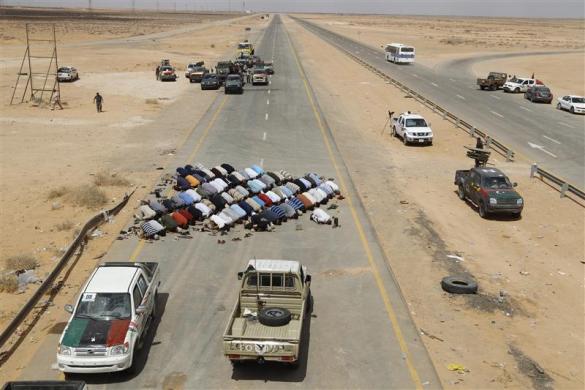
Former Libyan leader Muammar Gaddafi died of wounds suffered on Thursday as fighters battling to complete an eight-month-old uprising against his rule overran his hometown Sirte, Libya's interim rulers said.

His killing, which came swiftly after his capture near Sirte, is the most dramatic single development in the Arab Spring revolts that have unseated rulers in Egypt and Tunisia and threatened the grip on power of the leaders of Syria and Yemen.
"He (Gaddafi) was also hit in his head," National Transitional Council official Abdel Majid Mlegta told Reuters. "There was a lot of firing against his group and he died."
Mlegta told Reuters earlier that Gaddafi, who was in his late 60s, was captured and wounded in both legs at dawn on Thursday as he tried to flee in a convoy which NATO warplanes attacked. He said he had been taken away by an ambulance.

There was no independent confirmation of his remarks.
An anti-Gaddafi fighter said Gaddafi had been found hiding in a hole in the ground and had said "Don't shoot, don't shoot" to the men who grabbed him.

His capture followed within minutes of the fall of Sirte, a development that extinguished the last significant resistance by forces loyal to the deposed leader.

The capture of Sirte and the death of Gaddafi means Libya's ruling NTC should now begin the task of forging a new democratic system which it had said it would get under way after the city, built as a showpiece for Gaddafi's rule, had fallen.

Gaddafi, wanted by the International Criminal Court on charges of ordering the killing of civilians, was toppled by rebel forces on Aug. 23 after 42 years of one-man rule over the oil-producing North African state.

NTC fighters hoisted the red, black and green national flag above a large utilities building in the centre of a newly-captured Sirte neighbourhood and celebratory gunfire broke out among their ecstatic and relieved comrades.

Hundreds of NTC troops had surrounded the Mediterranean coastal town for weeks in a chaotic struggle that killed and wounded scores of the besieging forces and an unknown number of defenders.


NTC fighters said there were a large number of corpses inside the last redoubts of the Gaddafi troops. It was not immediately possible to verify that information.


TIMELINE - Libya's civil war

Here is a timeline of the civil war in Libya since protests against Muammar Gaddafi broke out in February:


Feb. 15/16, 2011 - The arrest of human rights activist Fethi Tarbel starts a riot in Benghazi.
Feb. 24 - Anti-government militias take control of central coastal city of Misrata after evicting forces loyal to Gaddafi.Feb. 26 - The U.N. Security Council imposes sanctions on Gaddafi and his family, and refers the crackdown on rebels to the International Criminal Court.
Feb. 28 - EU governments approve sanctions against Gaddafi and his closest advisers.
March 5 - The rebel National Transitional Council (NTC) in Benghazi declares itself Libya's sole representative.March 17 - The U.N. Security Council votes to authorise a no-fly zone over Libya and military action -- to protect civilians against Gaddafi's army.March 19 - The first air strikes halt the advance of Gaddafi's forces on Benghazi and target Libya's air defences.
April 30 - A NATO missile attack on a house in Tripoli kills Gaddafi's youngest son and three grandchildren, his government says.June 27 - The ICC issues arrest warrants for Gaddafi, his son Saif al-Islam and intelligence chief Abdullah al-Senussi on charges of crimes against humanity.Aug. 21 - Rebels enter Tripoli with little resistance. Gaddafi makes audio addresses over state television calling on Libyans to fight off the rebel "rats".Aug. 23 - The rebels overrun Gaddafi's fortified Bab al-Aziziya compound in Tripoli, trashing the symbols of his rule.Aug. 29 - Gaddafi's wife, his daughter Aisha and two of his sons enter Algeria. Aisha Gaddafi gives birth in a clinic in a border town hours after crossing the frontier.Sept. 1 - Libya's interim rulers meet world leaders at a conference in Paris to discuss reshaping Libya. Gaddafi, on the 42nd anniversary of his coming to power, urges his supporters to fight on.
Sept. 8 - Interim prime minister Mahmoud Jibril arrives in Tripoli on his first visit since it was taken by his forces.Sept. 11 - Libya starts producing oil again. Niger says Gaddafi's son Saadi has arrived there.Sept. 13 - Interim government chief Mustafa Abdel Jalil makes his first speech in Tripoli to a crowd of about 10,000.Sept. 15 - France's Nicolas Sarkozy and Britain's David Cameron land in Libya to a heroes' welcome.
Sept. 16 - The U.N. Security Council eases sanctions on Libya, including on its national oil company and central bank. The U.N. General Assembly approves a request to accredit interim government envoys as Libya's sole representatives at the U.N., effectively recognizing the NTC.Sept. 20 - U.S. President Barack Obama calls for the last of Gaddafi's loyalist forces to surrender as he announces the return of the U.S. ambassador to Tripoli. Gaddafi taunts NATO in a speech broadcast by Syrian-based Arrai television station.Sept. 21 - The interim rulers say they have captured most of Sabha, one of three main towns where Gaddafi loyalists have been holding out since the fall of Tripoli. Gaddafi's birthplace Sirte and the town of Bani Walid continue to resist.crude oil to be shipped in Sept. 25 - The first Libyan months sails from the eastern port of Marsa el Hariga for Italy.Sept. 27 - NATO says Libya's interim rulers have taken full control of the country's stockpile of chemical weapons and nuclear material.
Oct. 12 - Government fighters capture Gaddafi's son Mo'tassim after he tried to escape Sirte.
Oct. 13 - NTC forces say they have control of the whole of Sirte except neighbourhood 'Number Two' where Gaddafi forces are surrounded.Oct. 14 - Gunfights break out in Tripoli between Gaddafi supporters and NTC forces, the first sign of armed resistance to the new government.Oct. 17 - NTC forces celebrate the capture of Bani Walid, one of the final bastions of Gaddafi loyalists.
-- A Syrian television station confirms Gaddafi's son Khamis died in fighting southeast of Tripoli on Aug. 29.Oct. 18 - U.S. Secretary of State Hilary Clinton arrives in Libya on an unannounced visit, urges militias to unite.
Oct. 20 - NTC fighters capture Sirte, Gaddafi's hometown, ending a two-month siege and extinguishing the last significant hold out of troops loyal to the deposed leader.


NATO: aircraft struck pro-Gaddafi vehicles near Sirte

NATO said its aircraft attacked two military vehicles near Muammar Gaddafi's last holdout of Sirte on Thursday, but that it could not confirm reports these had been carrying Gaddafi.

"At approximately 0830 local time (0630 GMT) today, NATO aircraft struck two pro-Gaddafi forces military vehicles which were part of a larger group moving in the vicinity of Sirte," NATO military spokesman Colonel Roland Lavoie said. "These armed vehicles were conducting military operations and presented a clear threat to civilians."

Another NATO official said the alliance had not been able to confirm whether the air strike hit a convoy that Gaddafi was reported to have been in.
Earlier, a military official of Libya's ruling National Transitional Council, Abdel Majid Mlegta, told Reuters that Gaddafi had been captured and wounded in both legs at dawn on Thursday as he tried to flee in a convoy that NATO warplanes attacked.


A senior NTC military official later said Gaddafi died of wounds suffered in his capture.


NATO said on Thursday it was seeking confirmation from the NTC of reports that Gaddafi had been captured or killed in Libya, but said this could take some time. NATO says it does not target individuals unless they are a threat to civilians.


"We haven't been able to confirm these reports," a different NATO official said. "The situation is just too fluid. Events like this on the ground -- only the NTC would be able to confirm If it is true, then this is truly a historic day for the people of Libya."


NATO took over a U.N.-mandated military operation to protect civilians on March 31, since when it has been conducting air strikes and enforcing a no-fly zone in Libya, as well as enforcing an arms embargo through naval patrols.


The situation in Gaddafi's last holdout in Sirte would be a big factor in deciding when to end the mission, NATO officials said this week. They said the decision would be based on an assessment of the ability of the NTC to maintain security.


Thursday, October 13, 2011


The Deja Vu Disaster

Via Atlantic (AP Photo) A woman displaced by the floods walks along a flooded road holding an axe to cut wood, in Digri district near Hyderabad on September 19.
Last year, the floods in Pakistan were considered “one of the worst natural disasters in history,” affecting 20 million people and submerging about one-fifth of the country underwater. This year’s monsoon rains have once again wreaked havoc, affecting at least 5.4 million people, with more than 475,000displaced from their homes. The Washington Post cited the United Natons’ statistics, noting, “In Sindh alone, the floods have killed over 220 people, damaged or destroyed some 665,000 homes and displaced more than 1.8 million people.” Balochistan has also been affected by the floods. The Atlantic, in its coverage, reported, “The disaster has once again overwhelmed the capacity of the government to assist, and the UN has asked for $357 million in international aid.”
Given the enormity of the disaster last year, it seems we should have learned many lessons by now, at the very least how to better handle or address the impact of the floods, to better mitigate the human cost of the tragedy. And yet, here we are, exactly a year later, and the numbers are still climbing. A few weeks ago, Oxfam International‘s Pakistan Director stated to the Telegraphthat this year’s floods are “already worse than last year, not because of the numbers but the impact on a population already severely affected by last year’s mega-flood.
The director went on to note,
We have more and more mosquitoes, the water is contaminated, and there’s the risk of all the public health [diseases] because there is not sufficient clean water. It’s not just about the world recognizing it, but realizing it is something we need to respond to now. People who have been displaced for a second time can’t sleep at night. They’re on the sides of the roads without shelter, suffering from diarrhoea, they’re itching and scratching.
Before these latest floods began, nearly one million people from last year’s disaster were still without permanent homes. One. Million. That number is not only a reflection of the amount of people vulnerable during this latest tragedy, but also the inability of authorities and the international community to properly respond to those affected in the last year. Although the latest floods began in August, President Asif Ali Zardari waited until September 8th to ask for help (And now he has a “special control room.” I’m serious). BBC News‘ Orla Guerinnoted, “At that stage more than five million lives had already been disrupted by the floods.” She cited UN spokesperson Stacey Winston, who stated,
We responded immediately once we were asked…Officially for us to go in and set up shop, we have to be asked. Within days of the government’s request the World Food Programme had reached 140,000 people and the World Health Organization had reached hundreds of thousands with essential medical help.
And what of the government response now? When Guerin asked PM Yousaf Raza Gilani if more lessons could have been learned from last year’s disaster, he replied, “You can’t compare the two. Last year there was flooding from the Indus River, this year it’s from the rains.” Gilani also went on to stress thatfewer lives have been lost this year compared to last year – 350 versus 2000.
Um.
Human lives lost are human lives lost. We can’t compare or quantify in order to justify or scapegoat our actions, or lack thereof. Doing so will not help the families who are currently drinking the same contaminated water as their livestock. It will not restore the livelihoods of the millions who have watched their homes wash away year after year. How can these communities hope to rebuild their lives if they were not even given the tools to do so the first time around? How long before this cycle of disaster & dependency become what is considered normal?
In Pakistan, the monsoon rains are not unexpected. And God knows we have more than enough problems facing the country at this time. We have been inundated – literally and figuratively – with disaster, so much so, that we have been unable to keep afloat. But for those of us who care – and all of us damn well should – we can do more than just watch as our government fumbles yet again in the face of disaster.
In the latest Friday TimesFaisal Kapadia, who has done incredible relief work with Awab Alvi and others in Sindh [via SA Relief], wrote,
We may have good intentions but in time we get tired or the funds dry up and then we have no choice but to desert the communities we are adopting on ground. This is why I believe that every initiativeshould be tied to the local government and managed jointly. In this manner, the local government can point out where relief should be directed so no overlapping takes place. Often we have gone out with a plan in mind but have after being briefed by the local DCO realized that we must change direction because someone has already distributed relief there in the morning. Failure to coordinate with local officials leads to haphazard relief and then much grief for dependent communities.
This is a really important point. Sometimes in our efforts to help, we end up replicating what others have already done, making our attempts repetitive and relatively ineffective. I’ve also been interested in the nexus of innovation and relief, and how these types of solutions can become cost-effective ways of providing affected communities what they need rather than what we think they need. Organizations like Day One Response, which provides clean drinking water to those affected by disaster, can be potential stakeholders in the discussion.
So beyond listening, collaborating, and partnering with local officials and reputable relief organizations, think about how relief is only the first step in this recovery process. And while our energy is well-spent donating and supporting the relief phase, if the disaster taught me anything last year [viaRelief4Pakistan], it’s that this same energy slows in the rehabilitation stage, which is just as necessary.
Pakistan to grant MFN status to India


Pakistan has, in principle, decided to grant Most Favoured Nation (MFN) status to India, Foreign Minister Hina Rabbani Khar said in theNational Assembly


The minister said during question hour that the dialogue process with India had been initiated after a gap of two years, reported Associated Press of Pakistan. 


Khar said: "The topmost priority of the country is to ensure uninterrupted dialogue with India so that the resolution of core Kashmir could be ensured." 


"There are a number of achievements regarding relations with India. We have achieved ground on trade with India. First time in history, the Indian foreign minister had attended the reception of Pakistan foreign minister in New York," she was quoted as saying. 


During the past three years, the Jammu and Kashmir dispute has been discussed during all bilateral interactions between the leadership of the two countries as well as at the foreign secretary levels. 


"I raised the Jammu and Kashmir issue with my Indian counterpart at the ministerial meeting in New Delhi in July 2011. The joint statement of the ministerial meeting underscored the need for continued discussion of Jammu and Kashmir in a purposeful and forward-looking manner with a view to finding a peaceful solution by narrowing divergences and building convergences," the minister said. 


The MFN status could be a big step forward in strengthening trade ties between the two neighbours. Once MFN status is granted, Pakistan will have to treat India on par with its other favoured trading partners. India has already granted most favoured nation status to Pakistan and is treating it on par with other trading partners. 


Pakistan Commerce Minister Makhdoom Amin Fahim had visited India for five days last month. 


Currently, Pakistan's exports to India stand at $300 million, while imports from India are at $1.5 billion.

Comments


* If India is supposed to do something to increase Trade with Pakistan then it should do it. I think you better check what MFN really means.
Kashmir,Kashmir,Kashmir. Pakistanis have ruined themselves because of this. Economy is in shambles, your PMs and Presidents go on ‘Begging tours’, dominant military.
Kashmir is a problem which might never be solved on Pakistan’s interests. Its just not possible. As India rises and moves to a completely different level of playing field than that of Pakistan, it is in the best interests of both countries,especially Pakistan, to improve trade ties with India. If not its Pakistan’s karma, India will continue at a phenomenal rate and become one of the top 3 economies by 2040 even by current growth rates,which will only increase.
* I see a comment written in complete ignorance of history and economic cycles. Time will tell, it always has and it always does. Your macroeconomic indicators are great, the lives of your middle class and citizens however are nothing in tune to the amazing pace you talk of. Not even close. I visited India for quite a few trips, I got a fair number of sayings from people who had been at both sides of the border. A prominent one was “hum chaand pohanch jaaein ge par rahein ge inhi darboon mein”. (We Indians will reach the moon very quickly, but our houses will remain the size of chicken sheds.) You need to grasp some realities as well. Im good with you reaching the moon as long as I retain what I have. I know what MFN means, thankyou
Mr.Jibran,only time will tell whether India will be 3rd largest economy by 2040 or not.But what about Pakistan.Forget where Pakistan will stand economically in 2040,the question is whether Pakistan will be there as one nation or not.It seems you are facinated by India,I would request you to concentrate more on pakistan so that it can come to that level atleast where it will not to beg from US and other countries.
Thank you for your insightful comment and recommendations for me. Now please give me some time so I can provide you with a list of books to read regarding Naxalites, Nagaland, Operation Blue Star and the history of the separatist movement that is nowadays making news in the North. I am not fascinated by India however may I point out. Quite the contrary.
And, yes, Pakistan does fascinate me. I keep wondering how can a country which was once part of the Greater India, a Gandhian India, the country considered to the Jewel in the crown of the English Empire, turn out to be so fanatical, violent and destructive.

It makes me wonder how can that country uphold a divisive theory as the Two nation theory,which essentially says 2 set of human beings are different and which can institutionally declare(blasphemy laws for one) minorities,especially Ahmedis, to be lesser citizens than the over-whelming majority(who by the way are fighting among themselves be it on the Provincial level or ethnic level or Religious level).
Now here you have your biased history books talking. You wont find this in the Guardian or the New York Times or Der Speigel. Part of Greater India? The Muslim League’s elements only took up demand for a separate country AFTER some of the religious shenanigans conducted there by the Congress. In the final two efforts made by the British in India, the Cabinet Mission Plan and the Cripps Mission, something akin to solution was turning out. There was a federation being formed with provinces having right to secede after ten years in one case, but the federation was being kept intact. Muslim League accepted that proposal, Congress rejected it. They wanted ultimate control over the center. The whole ploy was that let this country be formed, it won’t be viable, it doesn’t have the infrastructure, it simply isn’t sustainable. The non-payment of funds from the Central Bank, train carriages being divided, not to mention a host of other resources that were due to Pakistan was a part in this ploy. In the end the country would come begging back in a few years for a federation again, when greater powers could be retained by the Center, a Congress held centre. It did not happen, the country survived. Despite all odds, the country survived. That’s the history you will never be told in your history book. The ones that do, you stigmatize.Head in the sand syndrome? India’s no where off. Please refer to the situation of some of your minorities. Here, you have ther unique case of the institutional put up and maintenance of a facade of calm, over anything that is but, helped of course by the Der Speigels’ and the Guardians’ home countries seeing economic benefits to turn a blind eye to them. This doesn’t last for long. When your eyes are able to pierce through the sand grains, then comment on my position please.
* Yes Pakistan supports the “Afghan” taliban. It is a well known fact. And it will. Its in its interest to do so. They are pashtun. Pakistan has a historic link with Pashtun. We support them because India supports the Tajik Northern Alliance, who are the power in Kabul. When the NATO forces leave, and they will, there will be a power struggle as last time and Pakistan wants its interests to be safeguarded there by the pashtun Afghan Taliban to vie for the centre so that the Indian supported, minority Tajik group does not come to power and Pakistan has a hostile neighbor that is a puppet for India, opening up 2 fronts. Its rational. Your international new media says so as well! The problem is not whether the international news media + India is flat, the problem is which one you allow yourself to read.