Sunday, November 20, 2011

Pakistan: 

A Personal History


Selective moral outrage in this part memoir, part history
suggests Imran Khan is playing to a powerful right wing

Imran Khan’s political star is on the rise in Pakistan.
Just as he did in his two-decade-long cricket career,
he is once again dazzling a fractured nation. This time,
his aim is not for the bat, but the ballot box.
But will Khan win in a nation that is dominated by
feudal politics,corruption, nepotism, old parties
and military interference?

Khan’s support among Pakistan’s kingmakers,
the media and military intelligence, combined
with his high poll ratings, are beginning to yield
 results in the form of vast gatherings of people
who attend his rallies. He is filling a political
vacuum in a land where there are few leaders.
His recent book, Pakistan: A Personal History,
is part memoir and part history, but it is mainly
his manifesto for creating change in Pakistan.


In the interests of full disclosure, I should mention that 
I met with Khan last month in London, thanks to my friend 
Jemima Khan, his former wife. He gave me a copy of his 
book, and we spoke about Sufism and his attraction towards it. 
Explaining the draw of this gentler, softer Islam of the hearts, 
he is sincere in person, as he is when he writes about it. 
Unlike Cat Stevens, the singer who converted to a more 
hardline, activist form of Islam, Khan’s rediscovery of his 
more contemplative faith has been steered by a spiritual 
mentor, Mian Bashir. 
Khan writes movingly of mystical encounters. 
He quotes extensively from Sufi philosophers such as Iqbal, 
and is comfortable within the Sufi tradition. But this quest 
does not extend to other aspects of Islam.


In his book, Khan adopts popular Pakistani thinking on 
Islamic politics without applying his critical faculties as 
well as he does on other areas of his religion and politics. 
For example, he writes: “Islam is not just a religion to 
be practised privately by individuals, but a way of life. 
The Quran lays out clear rules for how a society should 
be governed, and guidance on how people should behave.” 
This slipping into Islam-as-state-and-society is the mistake
 that extremists make, and then demand we all conform to. 
Fortunately, the Koran does not specify systems of governments, 
and uses the Arabic word dean, or religion, to describe Islam, 
Christianity and Judaism. So Islam is, like others, a religion – 
it does not demand theocracy.

But Khan is not always wrong. He claims, justifiably, that he was
ahead of his time when he criticised the militant pursuit of the war
on terror in Pakistan and Afghanistan, and was right in calling for
peace with less extreme elements of the Taliban, and others.

That policy is now being pursued, perhaps too late, by Pakistan
and the west. Khan writes compellingly about the culture and mindset
of tribal people in Pakistan’s’ Swat valley and the North West Frontier
Province. His book gives invaluable insights into the behavioural codes
of Pashtun tribes, and the rise of Islamist radicalism in Pakistan in the
wake of ongoing CIA drone attacks.

In both his book and his political role, Khan gives voice to this rise in
anti-American radicalism among elite Pakistanis. His story is that of
Pakistan’s elite: he was educated abroad, is addicted to cricket,
comfortable in English, an admirer of the British monarch, a wearer
of western clothes and yet harbours a deep antipathy toward the west.

As a political manifesto, Khan’s book is a rallying cry to these elites.
 It is also a message to the west, about the intricacies and
complexities of a rebellious Pakistan that feels humiliated
daily by American violations of its sovereignty. But he does not ask
why Pakistan cannot control its own territory. Had it subdued its
militants, the US would not need to be involved.

Khan writes compassionately about the poor and downtrodden in
Pakistan, but he does not touch on the plight of Christian Pakistanis
who suffer daily from the discriminatory blasphemy laws that can,
almost whimsically, condemn them to death. Nor does he write
about the second-class citizenship of Pakistan’s Shia and Ahmedi
Muslims, who are barred from opportunities and routinely face
harassment both as individuals and as communities.

Khan, rightly, writes and speaks about the need for political leaders
to disclose their assets, as he has done, in order to eliminate
corruption from public life. But why does he not write about the
need for similar disclosure of the wealth of military generals?
Or that of rightwing religious leaders?

These and other selective moral outrages, and the convenient
reading of Islam,suggest that Khan might be playing to a powerful,
religious rightwing gallery in Pakistan. As such, his book helps us
comprehend that audience, and how it is shaping westernised
Pakistanis such as Imran Khan.

The writer is a senior fellow at the Council on Foreign Relations 
and author of The Islamist
Pakistan: A Personal History, by Imran Khan, Bantam Press, £20, 400 pages


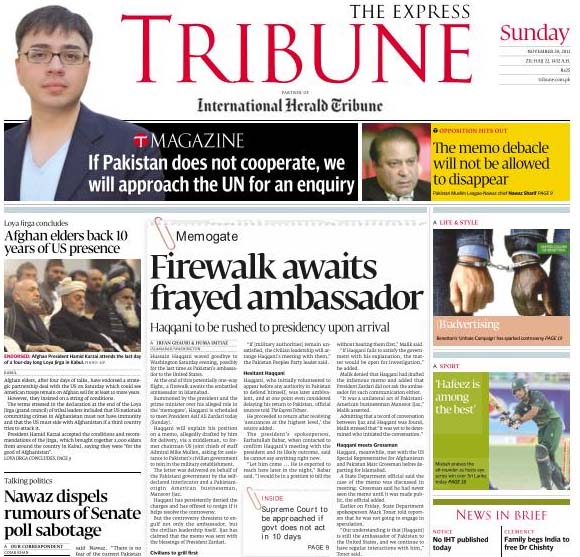
Memogate: 

Firewalk awaits frayed ambassador


Hussain Haqqani waved goodbye to Washington Saturday evening, possibly for the last time as Pakistan’s ambassador to the United States.
At the end of this potentially one-way flight, a firewalk awaits the embattled ambassador in Islamabad.
Summoned by the president and the prime minister over his alleged role in the ‘memogate’, Haqqani is scheduled to meet President Asif Ali Zardari today (Sunday).
Haqqani will explain his position on a memo, allegedly drafted by him for delivery, via a middleman, to former chairman US joint chiefs of staff Admiral Mike Mullen, asking for assistance to Pakistan’s civilian government to rein in the military establishment.
The letter was delivered on behalf of the Pakistani government by the self-declared interlocutor and a Pakistani-origin American businessman, Mansoor Ijaz.
Haqqani has persistently denied the charges and has offered to resign if it helps resolve the controversy.
But the controversy threatens to engulf not only the ambassador, but the civilian leadership itself. Ijaz has claimed that the memo was sent with the blessings of President Zardari.
Civilians to grill first
Haqqani, who boarded a Qatar Airways flight in Washington Saturday evening, is scheduled to arrive in Islamabad early Sunday morning, official sources said.
He would be taken to the Presidency right away, sources added.
“The president and the prime minister told General Kayani that they would first seek an explanation from Haqqani themselves,” a close associate of President Zardari told The Express Tribune.
The civilian leadership would then apprise the military authorities of the issue, he added.
“If [military authorities] remain unsatisfied, the civilian leadership will arrange Haqqani’s meeting with them,” the Pakistan Peoples Party leader said.
Hesitant Haqqani
Haqqani, who initially volunteered to appear before any authority in Pakistan to defend himself, was later ambivalent, and at one point even considered delaying his return to Pakistan, official sources toldThe Express Tribune.
He proceeded to return after receiving ‘assurances at the highest level,’ the source added.
The president’s spokesperson, Farhatullah Babar, when contacted to confirm Haqqani’s meeting with the president and its likely outcome, said he cannot say anything right now.
“Let him come … He is expected to reach here later in the night,” Babar said. “I would be in a position to tell the schedule once he arrives.”  An official in the Prime Minister House said the premier would be in Lahore on Sunday, for his son’s wedding, and is expected to meet Haqqani on Monday.
No treason charges yet
The government has no intentions of pursuing a treason case against Haqqani before giving him a chance to prove his innocence, Interior Minister Rehman Malik said while talking to journalists on Saturday.
“It is unjust to condemn someone without hearing them first,” Malik said.
“If Haqqani fails to satisfy the government with his explanation, the matter would be open for investigation,” he added.
Malik denied that Haqqani had drafted the infamous memo and added that President Zardari did not ask the ambassador for such communication either.
“It was a unilateral act of Pakistani-American businessman Mansoor Ijaz,” Malik asserted.
Admitting that a record of conversation between Ijaz and Haqqani was found, Malik stressed that “it was yet to be determined who initiated the conversation.”
Haqqani meets Grossman
Haqqani, meanwhile, met with the US Special Representative for Afghanistan and Pakistan Marc Grossman before departing for Islamabad.
A State Department official said the case of the memo was discussed in meeting. Grossman said he had never seen the memo until it was made public, the official added.
Earlier on Friday, State Department spokesperson Mark Toner told reporters that he was not going to engage in speculation.
“Our understanding is that [Haqqani] is still the ambassador of Pakistan to the United States, and we continue to have regular interactions with him,” Toner said.
PML-Q throws weight behind ally
Pakistan Muslim League-Quaid chief Chaudhry Shujaat Hussain threw his weight behind his ally, the Pakistan Peoples Party, on Saturday and said the ‘memogate’ controversy was ‘baseless’ and an effort to destabilise the civilian government.
Speaking in Bahawalpur, Hussain said that President Zardari was not a child who needed intermediaries for correspondence with the US government.

Saturday, November 19, 2011


Pakistan’s ambassador to Washington returned to Islamabad Sunday to explain himself over claims that he wrote a letter seeking US help against the country’s powerful military.
Hussain Haqqani, a close aide of President Asif Ali Zardari, has played a key role in helping Pakistan’s civilian government navigate turbulent relations with Washington that nosedived over the US raid that killed Osama bin Laden.
Local media reports implicated Haqqani in a memo allegedly sent from Zardari to Admiral Mike Mullen, then America’s top military officer, seeking to curtail Pakistan’s military shortly after it was humiliated by the bin Laden killing.
Zardari reportedly feared that the military might seize power in a bid to limit the hugely damaging fallout in Pakistan after Navy SEALs killed bin Laden in the garrison city of Abbottabad on May 2.
The alleged memo, released last month by American businessman Mansoor Ijaz, said that a “new national security team” in Pakistan — with US support — could end ties between Pakistani intelligence and Islamist militants.
A senior government official told AFP that Haqqani “arrived early Sunday and is due to attend several meetings including a meeting with the President to explain the situation”.
Haqqani has offered to resign over the row, but has denied any involvement with the document.
Pakistan’s opposition leader Nawaz Sharif on Saturday demanded an independent commission to investigate the issue.

Pakistan's US envoy returns home amid scandal
Pakistan's ambassador to the U.S. says he has returned home to answer questions about his alleged involvement in a secret memo scandal that threatens his job.
Ambassador Husain Haqqani says he arrived in Islamabad on Sunday.
A U.S. citizen of Pakistani origin, Mansoor Ijaz, has accused Haqqani of masterminding a memo sent to a senior U.S. military official asking for help to rein in the Pakistani military after the American raid that killed Osama bin Laden inPakistan in May.
Haqqani has denied the allegation that he was behind the memo but has offered to resign to end the controversy.
The scandal has exacerbated tensions between Pakistan's weak civilian government and its powerful military.

Pakistan memo puts pressure on Zardari


High quality global journalism requires investment. Please share this article with others using the link below, do not cut & paste the article.

Asif Ali Zardari, Pakistan’s president, is facing pressure from his opponents over allegations that he sought to strike a deal with the US to help him assert control over the country’s powerful military.

Pakistan’s political scene has been hit by a claim that Mr Zardari authorised his ambassador to Washington to approach a top US official for help in preventing a coup in the tense days after the raid that killed Osama bin Laden in May.

High quality global journalism requires investment. Please share this article with others using the link below, do not cut & paste the article.

The controversy erupted on October 10, when Mansoor Ijaz, a US businessman of Pakistani origin, wrote an article in the Financial Times claiming he had served as a conduit for a memorandum setting out Mr Zardari’s plea for US backing in a showdown with the military.
Pakistan’s government had dismissed Mr Ijaz’s claims as a “fantasy” and his account was initially met with scepticism in much of Pakistan’s boisterous media.

But the affair roared back into life this week when Admiral Mike Mullen, a former chairman of the US joint chiefs of staff, confirmed he had received a memo of the kind described by Mr Ijaz, although he did not find it credible.
That revelation has sparked a fresh political storm in Pakistan, where Mr Zardari’s critics have demanded the government provide a full account of where the memo originated, who authorised it, and what it was designed to achieve.

“The government needs to come clean over whether President Zardari was somehow involved in this memo,” said Khurram Dastgir Khan, one of several opposition lawmakers to raise similar questions in the National Assembly on Thursday.
“Shenanigans like this are not the way to conduct foreign policy.”

The affair, dubbed “Memogate” by one columnist, has provided a glimpse into a determined but usually opaque power struggle between civilian officials and the generals who still wield enormous hidden influence after decades of army rule.

Analysts say Mr Zardari runs the risk that his enemies will seek to portray the memo as evidence that his government was contemplating an act bordering on treason by asking the US – which many Pakistanis regard as hostile – to rein in the army, which has spent decades cultivating an image as a guarantor of the country’s integrity.

Mr Ijaz, a venture capitalist, initially wrote in the FT that he had served as an informal conduit to deliver the memo to Adm Mullen a week after Bin Laden’s death on May 2. Mr Zardari, he wrote, felt he needed “an American fist” on the desk of General Ashfaq Kayani, Pakistan’s army chief, to prevent any risk of a coup following the Bin Laden raid, which humiliated the army.
In return for US support, the government offered to stop Pakistan’s intelligence agencies backing militants fighting Nato in Afghanistan, according to Mr Ijaz. To do this Mr Zardari would sack key generals and introduce a civilian-led security team.

Mr Ijaz told the FT on Thursday that he had been asked to deliver the message by Husain Haqqani, Pakistan’s ambassador to the US, and an ally of Mr Zardari.

“Husain Haqqani, whom I have known for over 10 years, was indeed the senior Pakistani diplomat who asked me to assist him in privately delivering his message to Admiral Mike Mullen,” Mr Ijaz said. He also detailed phone and email contact between himself and Mr Haqqani in May as they finalised the draft of the memorandum and awaited “the boss’s approval”. “The boss was an obvious reference to President Zardari,” Mr Ijaz said.
Mr Haqqani, who has emerged as an influence in the fraught US-Pakistan alliance since taking his post in 2008, has denied any involvement.

But he has been recalled to Islamabad to explain his position. On Thursday, he told the FT he was prepared to resign if doing so would defuse the controversy and lashed out at Mr Ijaz.
“The back and forth and media manipulation involving the businessman who started this controversy with his op-ed [article] has been exploited by opponents of Pakistani democracy to drive a wedge between our civil and military leaders,” Mr Haqqani said. “The individual who started this controversy with his op-ed might consider his ego more important than Pakistan; I do not.”

Pakistani officials made no comment on Thursday on whether Mr Haqqani’s offer to resign had been accepted and he remained in Washington.

The furore is being watched in Washington where the US is torn by its historic reliance on cultivating strong ties with the military, Pakistan's most powerful institution, while also hoping to foster greater democracy and bolster the prospects for long-term stability.
However, those hopes are complicated by the weakness of Mr Zardari's
administration, which has been hobbled by an entrenched legacy of corruption and the triumph of personality politics over institutions.

The storm over Memogate has also pumped up an already feverish political climate with a roster of the country’s best known diplomats, spymasters and politicians using the affair to push their competing agendas ahead of elections due in early 2013.

Shaukat Qadir, a retired brigadier who writes on security issues, said the military was pressing the government to sack Mr Haqqani. “The question is how much pressure there will be on Zardari, and what that pressure will get him to do,” he said.

The controversy flared on Wednesday when Adm Mullen revised an earlier claim that he could not recall receiving the memo and confirmed it had been sent to his office. Adm Mullen said through a spokesman that he had not believed the memo’s contents were credible.


Wednesday, November 16, 2011


Zardari’s Sister Faryal Talpur-Owned Indus Air to replace PIA

 Zardaris Sister Faryal Talpur Owned Indus Air to replace PIA
KARACHI: There is not a single day without any news about Pakistan International Airline, but not for any good reason rather all about its ailing financial health, poor performance, flights delay, emergency landings and etc.
But there are some latest and stunning revelations that the ailing national flag carrier is being pushed to dead-end deliberately just to pave the way for a new private airline reportedly owned by a close relative of the President House’s inhabitant.
Though the state-owned airline’s financial health was not good before the incumbent dispensation, but during the tenure of this government it moved from bad to worst despite the repeated and consistent calls from all the quarter for restructuring and overhauling of the airline to restore its past glory.
As the airline is fast nearing toward collapse, there are startling reports that a private airline reportedly owned by a close relative of holder of top constitutional office of the country is being launched, which will replace the national flag carrier.
Reliable sources in the airline industry told The News Tribe that the national flag carrier was being deliberately pushed toward collapse so that the way could be paved for the new airline.
They claimed the new airline, Indus Air, is owned by Faryal Talpur MNA, sister of President Asif Ali Zardari, They further said that the news of PIA planes’ crash landings, technical faults and flights delays were being propagated purposefully on daily basis and despite repeated call no step had been taken for complete overhaul of the airline so that the PIA could be declared bankrupt and unfeasible entity.    Despite repeated attempts the News Tribe cold not reached out to Faryal Talpur for her version about the issue.
The Indus Air reportedly owned by Mrs Faryal Talpur is a company registered in Bahamas and will become operative very soon, they sources confided to The News Tribe.
The sources said that the airline will be run by former Managing Director PIA Ijaz Haroon, who was removed as MD PIA after prolong strike and protest by PIA employees and pilots.
The website of the Indus Air says that the airline will be launched soon. According to the site, which displays the routes of the airline through map, the airline will run its flights to almost all domestic stations in Pakistan to which the PIA currently operates flights. The airline will operative flight on almost all domestic routes, besides major international routes.
Interesting, the domestic routes of the airline include those on which no private airline currently runs flight and as per PIA management, these routes are financially unviable such as flight from Peshawar to Chitral and Rawalpindi to Gilgit and Skardu.

India, Pak talk trade route to peace


Pakistan to open flood gates for Indian goods in February, on way to MFN


 In a clear signal of thaw in bilateral ties, Pakistan today agreed to open its market for over 7,000 items from India in the next three months and promised to grant New Delhi crucial MFN status by 2012 end.
At the end of two-day talks between commerce secretaries of the two countries here, Islamabad agreed to widen market access for Indian goods by moving from a Positive List (PL) to Negative List (NL) trade regime by February 2012.
It would translate into a huge opportunity for Indian businessmen who will be able to ship all but few items to a 150 million Pakistani market through land, air and sea routes.
"In the first stage, Pakistan will transition from the current PL approach to a Negative List...A small NL shall be finalised and ratified by February, 2012.
"Thereafter, all items other than those on the Negative List shall be freely exportable from India to Pakistan," a joint statement said. At present, Pakistan allows import of only 1946 Indian items, listed in the PL.
India-Pakistan which saw their relations touch new low after the Mumbai terror attack in November 2008, have been reaching out to each other in the past few months realising trade can bridge their political gaps.
"They (Commerce Secretaries) expressed hope that positive developments in the trade track would encourage similar progress in other components of the dialogue process," the statement said.
While on MFN, Pakistan Commerce Secretary Zafar Mahmood said that this was not "an award or degree", it would be granted when the two countries do away with any PL or NL.
This is expected before end of 2012, as per the timeline set by the two sides. "This would be MFN for India with least political discomfort in Pakistan," a key source said.

Facebook profile spam porn -- Anonymous Fawkes malware?


Anonymous logo By  (@richi ) - November 16, 2011.
[Updated with more info and comment]
 
Facebook feeds everywhere have been filled with porn and violence spam. In what is perhaps the biggest Facebook hack to date, the social network is battling to contain the startling imagery. In IT Blogwatch, some bloggers finger Anonymous' Fawkes virus, but others say it's the same-old same-old.
 

Tuesday, November 15, 2011

Syria uprising falls victim to power plays

Syrians continue to be victimized, not only in violent clashes with the Syrian military, but also by regional and international players with various agendas.

Protests in Syria began on January 26, and a more inclusive uprising was set in motion on March 15. The initial demand was for serious political reforms, but this was eventually raised to a demand for full regime change, encompassing the unconditional departure of President Bashar al-Assad and his Ba'ath Party, which has ruled Syria for decades.

Soon, there was a deadlock. The uprising failed to weaken the links between the regime, army and other security agencies. It also remained confined to areas outside the two most populated cities, Damascus, in the southwest, and Aleppo in the north.

On the other hand, protests seemed extensive and prevalent enough to reflect a real sense of outrage at government practices, which grew with the reported deaths of Syrians all over the country. Despite a relentless military crackdown, and the killing of 3,500 Syrians (according to a recent United Nations human-rights office report), the government has not been able to quell the uprising, nor to provide a convincing political initiative that could spare Syria further bloodletting.

It could be argued that the impasse originated in Syria's own political culture, espoused by the Ba'ath Party's legacy of shunning dialogue in times of crisis. More, those who ultimately designated themselves as Syria's opposition remain largely divided, and often seemed to provide conflicting roadmaps for achieving democracy.

Earlier revolutions in Tunisia and Egypt were spared the terrible fate of people's priorities becoming merely another agenda item to be decided by outside powers. Both revolutions had quickly reached the critical mass required to topple their dictators, denying outsiders the chance of meddling in the outcome.

The situation in Syria, however, developed at a different pace. The uprising lacked the full support of the urban middle class. The army neither broke away from the ruling party, nor remained neutral. Additionally, months of violence - in which a successful Western military intervention in Libya toppled the regime of Mummer Gaddafi - provided outside powers with the needed time to position themselves as the caretakers of Syria's future. In other words, a popular uprising was decidedly hijacked and is currently being managed from Western and Arab capitals.

It was as though ordinary Syrians began realizing that their vision of achieving revolution from within was futile, and they bought into the illusion that only outside intervention could bring lasting change. These voices were emboldened by members of the Syrian National Council - seen as the lead opposition to the Ba'ath regime - whose behavior seemed to model that of the Libyan National Transitional Council.

The latter had blithely welcomed the North Atlantic Treaty organization (NATO) to Libya, initially to "protect civilians" from possible Libyan army retaliation, but eventually to carry out an airstrikes campaign that largely increased the number of deaths in Libya.

Adopting a model that rationalizes foreign intervention - which is incapable of exacting change without extreme violence - will bring horrible consequences for the Syrian people and the whole region. With the Syrian government failing to win the trust of large segments of the Syrian population, the opposition's growing dependency on outside forces, and some Arab media networks fanning the flames of sectarianism and civil war, the Syrian deadlock is morphing into something even more dangerous: a Lebanon-style civil war or a Libyan-style foreign military intervention.

The fate of Syria is no longer likely to be influenced by the Syrian people themselves, nor by their government. All eyes are now on the United States. US Secretary of State Hillary Clinton tried to clarify the US position in her recent comments. In the case of Libya, NATO and Arab countries banded together "to protect civilians and help people liberate their country without a single American life lost", she said.

But in other cases, as in Syria, "To achieve that same goal, we would have to act alone, at a much greater cost, with far greater risks and perhaps even with troops on the ground." For now, according to Clinton, US priorities in the region would have to remain focused on "our fight against al-Qaeda; defense of our allies; and a secure supply of energy".

Russia and China, worried that another US regime change venture could jeopardize their interests in the region, remain steadfast behind Damascus and critical of the factions that oppose the Assad regime. "We are concerned with news of ongoing aggression by extremist gunmen such as those which took place in Homs, Hama and Idlib in recent days with the provocative aim of forcing security agencies and the army in Syria to retaliate, and then launching a campaign via international media outlets," said Russian Foreign Affairs Minister Sergey Lavrov in a recent statement.

The lines are thus drawn, between a US-led Western camp and Russia and its own camp, which vehemently rejects a repeat of a Libyan scenario in a volatile region of unmatched geopolitical significance.

Whatever the outcome of this tussle, the Syrian uprising is increasingly being deprived of its own initiative. Currently, the issue of Syria is being entrusted to the Arab League, which lacks both credibility (since it is too divided between regional interests) and any history of successful political initiatives.

On November 2, Syria announced that it had agreed to an Arab League plan which called for the withdrawal of security forces from the streets, the release of prisoners and talks with the opposition.

However, after this did not happen and the violence continued, the Arab League voted on Saturday to suspend Syria's membership.

At the same time, King Abdullah of neighboring Jordan urged Assad to stand down. He told the BBC that if he were in Assad's position, he would start talks to ensure an orderly transition.

"I would step down and make sure whoever comes behind me has the ability to change the status quo that we're seeing," King Abdullah stated in an interview with BBC World News television.

Despite the Arab League's decision to suspend Syria, it is very probable that some Arab countries are keen to employ the league in a similar fashion to the way it was used with the war on Libya: a mere springboard that eventually allowed NATO's war to take place.

Signs of such a scenario are becoming clearer, especially following the league's vote to suspend Syria. In a New York Times editorial on November 8, the role of the Arabs seems to be confined to just that. The Arab League "should eject Syria and urge the United Nations Security Council to condemn Mr Assad and impose international sanctions against the regime", the Times counseled.

"Russia and China will find it harder to block a Security Council resolution - as they did in October - if the Arab world calls for action that goes beyond the sanctions already imposed by the United States and Europe."

And so the saga continues. If Syria doesn't wrestle its fate from the hands of these self-serving forces, the Syrian uprising and Syria as a whole will continue to be marred by uncertainties and foreboding possibilities.

Ramzy Baroud (www.ramzybaroud.net) is an internationally-syndicated columnist and the editor of PalestineChronicle.com.


Wednesday, November 2, 2011

With 7 Billion People, Facts Are No Longer Optional

Making data and analysis tools available to all takes the rhetoric out of decision making.

Almost half of the population of Pakistan is under the age of 19. Think about that for a moment; what would life be like here, if half the people in this country were under 20? When you dig deeper into Pakistan’s numbers you see that only 21%, so 1 in 5, of their 42 million young people is enrolled in secondary education. And of these, only 43% are girls. Certain patterns begin to take shape when you now overlay economic impact data onto this education data. You see, for example, that each year of secondary schooling increases girls’ future wages by 10 to 20 percent. This compares positively to the 5 to 15 percent increase that an extra year of schooling gives the boys. So the facts are very clear; Pakistan needs to invest in girls’ education to support the economic well-being of the country. No rhetoric required – an analysis of the numbers shows which way to go.

Until recently a fact-based analysis of these numbers would have taken months of pulling data from spreadsheets from hundreds of schools, departments and government agencies. It would have been complicated and costly. Today, thanks to newly created interactive population dashboards that SAP designed and built for the UNFPA (United Nations Population Fund) using UN data from multiple agencies, anyone can access, interact, click around and overlay this information. The data and – even more significantly – a tool to analyze it, are now in the hands of the people, not just for Pakistan, but for countries across the globe.


Tools of this nature will become more prevalent in the coming years. In the age of Google and Facebook, transparency and crowd-sourced knowledge will win the day. As a matter of fact, they may be the only way that we can continuously improve a world of 7 billion people and more. How will we manage our finite resources? How will we ensure a continuous increase in the global standard of living, not only for the few at the top, but also for the many working to get there?  Today, more than three billion people still live on less than $2.50 a day and at least 80% of the world’s population lives on less than $10 a day – hardly a sustainable model. The availability of data along with the tools to analyze it will help the world run better and, ultimately, improve people’s lives.
 
The key force behind population momentum can be achieved if the average age at which women begin childbearing rises (by delaying the first birth) and through wider spacing between births. Increasing the average age at childbearing by five years could reduce future population size by 20 percent.
 
But young women in Pakistan often have little choice about when or whom to marry, and whether to defer childbearing. The early onset of fertility and the close spacing of births present health risks to young women, limits their education and livelihood possibilities. The longer girls stay in school, the later they marry and the greater the power in a marriage to delay or space childbearing. Delaying the onset of childbearing will significantly impact their lives.

Pakistan is at a critical juncture in its demographic transition. After decades of very rapid population growth, the prospect of slower growth lies ahead because fertility is declining. But the timing and extent of further fertility declines is critical for Pakistan’s future. The population projected for 2050 may reach 395 million if no further fertility decline occurs and could be much lower at 266 million if fertility decline is rapid. The call for action to expedite the fertility transition is now.

The writers are the Vice President and Distinguished Scholar, Population Council, New York, Country Director and Director Research at the Population Council, Islamabad